Friday, January 25, 2008

The Consolation of Music


My semester begins next week, and I'll be teaching my writing class for music majors again, as well Introduction to Music, a 101-level class. My department offers twenty sections of Music 101, all of them taught by adjuncts; teaching 101 is a necessary rite of passage for anyone aspiring to the tenure track. As I prepare my syllabus, however, I feel daunted and overwhelmed. I've never taught a survey course to non-majors, and I wonder if I'll ever be able to find the right language to introduce Western classical music to students for whom it will be completely new. How do I explain to them how important the standard repertoire is to the soul and conscience of late-modern humanity, as I believe it is? How does one "eff" the ineffable? Those of us who work in and with music are, I think, incredibly fortunate: we hold a small but powerfully-honed tool that is capable of extending the consolation of beauty into an often bleak world. I hope with all my heart that, in some tiny way, I will be able to do this for my students this semester. I'll certainly be calling on all the musical saints for help.

Saturday, January 19, 2008

The Voices That Have Gone, Part 7


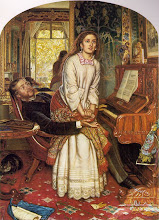
My husband likes to listen to the 1957 Sir Thomas Beecham recording of La Bohème, not because he’s a connoisseur, but because it’s the one we have (I used to also have the von Karajan recording with the luminous young Pavarotti and Mirella Freni, but I gave it to my ex-husband years ago and haven’t had the heart to replace it). The Beecham recording features Victoria de los Angeles (above) as Mimì, Jussi Bjoerling as Rodolfo, Robert Merrill as Marcello (my favorite character in this opera), and Lucine Amara as Musetta. Sometimes it’s almost too much for me to hear these wonderful singers, all dead except Amara. No one sings like that anymore: the plangent, conversational, extremely feminine singing of de los Angeles is sui generis, as are Bjoerling's passionate yet slightly restrained Italianate style and Merrill’s combination of wit, warmth, and virility. The deaths of singers in the past year and a half have hit me very hard: Pavarotti, Beverly Sills, Jerry Hadley, and especially Lorraine Hunt Lieberson, whom many a sensitive young mezzo idolized fiercely for her depth of soul and her fragile humanity. But then again, sometimes I can’t even stand the thought that Beethoven is dead. I heard a recording yesterday of Yo-Yo Ma and Emmanual Ax playing his Variations on “Bei Männern, welche Liebe fühlen” from The Magic Flute (WoO 46), and it struck me as the most perfect music ever written; and I longed for those days in Vienna at the turn of the nineteenth century, when, at least in my imagination, the soul was less fettered and there was a lot more great music around to ease the pain of life.

Tuesday, January 15, 2008

The Cross, Part 2


"If the soul does not free itself by way of the cross it can never be free. It is the tremendous surgical operation which the Father himself carries out on the flesh of his son in order to save him. And it is a dogma of faith that without the cross 'there is no forgiveness.' A mystery, but it is so. Pain purifies love. It makes it true, real, pure. And in addition it gets rid of what is not really love. It frees love from pleasure which falsifies it like a mask. It makes it a gift freely given.

When the flood of pain has passed over the soul, what remains alive can be considered genuine. Certainly not much remains. Often it is reduced to a thin shrub. But on this the dove of the Holy Spirit may rest to pour out his grace. It is reduced to 'yes' murmured among tears and anguish, but echoed by the all-powerful 'yes' of the dying Jesus; it is reduced to a child who has ceased to argue with God and men, but is helped on by the kiss of the Father."

--Carlo Carretto, Letters from the Desert

Saturday, January 12, 2008

The Cross


I signed up recently to get the e-newsletter of Canadian Catholic artist and writer Michael D. O’Brien. I have not yet read any of his novels, but have a couple of them on request through the public library. They seem to be popular; although I made my request a few weeks ago, they still haven’t arrived at my library branch. What interested me in O’Brien is the fact that two of his novels feature as their hero the fictional Fr. Elijah Schäfer, a Jewish convert to Catholicism and a Carmelite priest. As some of my readers know, the current focus of my scholarly work is the association between music and conversion, and I have a special interest in conversion stories (interestingly, the Carmelite path is one that has traditionally brought Jewish converts into the Church, the most famous examples in our time being Saint Teresa Benedicta of the Cross, who was martyred, along with her sister Rosa – also become a Carmelite nun – at Auschwitz. Carmelite saints Teresa of Avila and John of the Cross were also of Jewish extraction, though it was their parents who converted). O’Brien is also a wonderful icon painter who incorporates native Canadian techniques and iconography into his work.

His monthly newsletter arrived in my inbox this morning, and it was astonishing. He writes about the culture of moral relativism (i.e. the culture of death) in a fresh, illuminating way that transcends the defensiveness and partisan bitterness I’ve come to expect from American conservative Catholics, who sometimes have a bunker mentality when it comes to accommodation with the current state of things. One of the hardest things for me to accept in the wake of my own conversion from being a semi-glamorous and entirely selfish single New York singer is that the values I once held, while in keeping with this state of things, are antithetical to the way of life I now attempt to espouse. I often console myself for this by telling myself that the conservative Catholics around me are anti-intellectual Philistines who can’t possibly understand how important my life and work are (until I remember that arrogance and pride are among the defects I must work the hardest to conquer).

Reading O’Brien’s newsletter, however, has made me understand why my old values and lifestyle are not in keeping with the new life I stive for. “The economy,” he writes, “continues to inflate according to the now dominant model of family income: The majority of households in my country [Canada, though it might as well be the United States] are double-wage families with two or less children. The cost of housing, food prices, clothing, in fact the cost of almost everything, rises and rises. Contraception, sterilization, and abortion are the foundation stones of this economy [italics added]. So, too, is greed-profiteering, avaricious forms of speculation, and that old thing condemned by God... Usury. Yes, unfair interest, the backbone of our economy. . . . Those who do not play by those deadly rules have many crosses to bear. These extra crosses are due to the sins and blindness of others. Too often, a conscious or subconscious rationalism has infected the thinking of contemporary man, even men of good will, and one could go so far as to say many a churchman as well. In their assessments of what is 'reasonable' and possible for marriage in our times they have minimalized, or dismissed altogether, the factors of grace and the transforming power of sacrificial love. It's a temptation to get bitter about it. But we mustn't. The Cross is always unfair. Jesus's cross was the biggest unfairness of all time. But he bore it like a lamb and he turned it into a sign that confounded every device of the enemy. “

O’Brien goes on to exhort his readers to “do the impossible. Let us indeed do what rationalists cannot understand, that is, let us do the supra-rational thing, the eternal thing incarnated into the present moment. I mean, begin to praise and thank God for each and every one of the trials he permits in your life. Then watch what He does. He works everything to the good for those who love him. Don't give up, keep on praising and thanking, and locked gates will open, unhealable wounds will heal, the kremlin walls of hopeless situations will crack and let in light. One crack at a time, one brick falling at a time, one victory at a time. One step at a time and only enough manna for one day at a time, just as it was for our forefathers in the desert. . . . in this way we will advance in the Great School of the Soul that is married life and family. For none of us will it be easy. In taking our first tentative steps of radical trust, we will grow stronger, and I think wiser, and then our strides will become longer and more sure. Trust grows the more we practice trusting. And with it love grows, and in the process the unexpected occurs, the ‘impossible’ in the midst of the glorious ‘ordinary.’”

Inspiring words, and strangely timed to coincide with similar advice I received yesterday. I had gone to the church in the garment district in whose thrift shop I bought my beautiful wedding dress (which I’ll blog about later), where I hadn’t been in almost three years. It’s a rather decrepit old church, which I suspect is on the archdiocese’s list to close, but it’s beautiful inside, filled with icons and lit with dozens and dozens of real candles. I got onto the confession line, and when it was my turn, was astonished to receive a simple instruction that was nonetheless radical and transformative. As some of my readers know, I experienced both an ectopic pregnancy and a miscarriage in the past year, and a priest in my parish told me that God might be chastising me for the past sin of abortion committed seventeen years ago, for which I’ve long since been absolved. When I asked him how such chastisement could be squared with God’s promise to Jeremiah to “forgive their sins and remember them no more,” this priest cautioned me against “taking scripture out of context like the Protestants do.” After several weeks of despair, I decided that this what he said was simply a lie, and it ruined my relationship with him, whom I had considered a friend.

The priest in the confessional yesterday, however, said something that changed my heart. What my parish priest meant, he suggested, was that God allows us to suffer so that we can join our sufferings to His on the cross and offer them to Him in reparation for our sins. This seemed so different from the punishment I had inferred from my parish priest’s words, so different from the cynical spiritual economy I had imagined as God killing two of my babies for the one I had killed. I decided to try it, and to experiment with the belief that God’s allowing us to suffer might be for our good rather than for our spiritual destruction. The arrival of Michael O’Brien’s newsletter today illuminated this theology of suffering for me in a timely and beautifully cogent way.

Monday, December 31, 2007

Two Years On


My son will be two years old this week. Everybody tells you that "the time goes so fast,” but it doesn’t seem real until you are looking at a big boy who just a moment ago, or so it seems, was a tiny newborn cradled against your heart. When he was born, I was afraid to revel in him; I always felt as if a Damocles’ sword was hanging over me, as if he’d be taken away by a cruel fate if I dared to fall too deeply in love with him. The days rocking him, holding him, nursing him seemed endless, but in my memory now they seem as if they were just one long day. There is so much I can’t remember.

My prayer for him is the same as any mother’s prayer for her child: that he’ll be happy and healthy, that he will know and love God, and that he will be free from the torment and strife that shaped my own childhood and adulthood. But I also hope that he will love the things that I love, not out of vanity, but because the things that I love, chief among them music and poetry, took the child of torment and strife that I was and helped to fashion me into something more graceful, more giving, and far better able to love what is beautiful in the world.

The French composer Oliver Messiaen wrote a song in 1930 called “La fiancée perdue,” a setting of his own text. The last words are, in translation: “O Jesus, bless her! Her! Give her your powerful grace! That she may know nothing of suffering, of tears! Give her tranquility, Jesus!” In spite of the exclamation points, the music in this final section of a very loud and fast song is extremely calm and restful, and dwindles away into silence. I also pray this for my son.

Tuesday, December 25, 2007

Merry Christmas


Love bade me welcome, yet my soul drew back,
Guilty of lust and sin.
But quick-ey'd Love, observing me grow slack
From my first entrance in,
Drew nearer to me, sweetly questioning
If I lack'd anything.

"A guest," I answer'd, "worthy to be here";
Love said, "You shall be he."
"I, the unkind, the ungrateful? ah my dear,
I cannot look on thee."
Love took my hand and smiling did reply,
"Who made the eyes but I?"

"Truth, Lord, but I have marr'd them; let my shame
Go where it doth deserve."
"And know you not," says Love, "who bore the blame?"
"My dear, then I will serve."
"You must sit down," says Love, "and taste my meat."
So I did sit and eat.

-- George Herbert

Thursday, December 20, 2007

The Womb and the Garden


In the late 1990s, a wealthy and eccentric widow gave me a small scholarship to further my voice training. I took the money and sought out the New York City opera coaches whose auras had the most sheen at the time. I had some interesting experiences, and got lots of advice, all of it different. One Famous Coach told me that if I sang repertoire that was just a little too light for my voice, I'd "work everywhere." Another plied me with martinis and explained his sudden infatuation (of which I was assuredly not the only object) by saying that I was the only soprano he'd ever met (I had not yet made the switch to mezzo-soprano) who could carry on a conversation about something other than her hair and her gowns, and who knew how to pronounce HUAC correctly. When I went to use this Famous Coach's bathroom, I found a Duane Reade bag hastily tossed on the floor with a giant box of Trojans spilling out of it. This same Famous Coach, after my first marriage ended, told me, with perhaps a touch of bitterness, that I had lost my ambition, and that if I didn't get it back, the only thing I'd ever be known for was the guys with whom I'd "hooked up."

But the most interesting of the Famous Coaches was an unusually funny, kind, maternal, self-effacing middle-aged woman. She worked almost exclusively with the breath, trying to tailor the way her clients breathed to the sound, size, and ethos of their voices and musicalities. I wonder what she's doing now; she really was a wonderul person. At that time, she was trying to have a baby, and I hope it happened, as she would have been a wonderful mother.

I worked with her during a terrible time in my life, the year when my first marriage was ending. She knew what was going on, and asked me one day, "Do you want a stack of programs at the end of your life?" "Yes," I said, not really understanding why she thought any singer wouldn't. "Is that ALL you want?" she asked more pointedly. "Ummmm . . . no," I conceded, none too convinced myself. "Then don't f*ck up," was her reply. That was surely the best piece of advice I got during my time of fancy, expensive vocal coaching, and one that I wish I had taken.

She told me something else that has stayed with me: the Hasidim believe that when we are gestating in the womb, we know everything that is going to happen in our lives. But at birth, God lays His hand on our heads, and we forget everything, because if we remembered we couldn't bear it. The mark of this action of God is the soft spot on the newborn's head.

I wonder if, according to the Hasidic legend, the infant in utero is like Adam just after he's eaten the fruit, before being rebuked by God; and if the newborn baby is like Adam after the fall.

Sunday, December 16, 2007

John Cage in Living Color


It's the end of what feels like a never-ending semester, and the other day, the student for whom I designed a grant-funded tutorial on extended vocal techniques performed John Cage's "Aria" before the university music department's diversity committee (the committee had funded my grant in the hope of attracting more minority students into academic music studies). I had been worried about how all of this would turn out; how does a nineteen-year-old black girl from Canarsie convincingly interpret what is now a rather stilted, static, and dated piece by perhaps the whitest of American composers? Well, my fears were laid to rest, because S. did an amazing job. Cage notated his score with colors and lines, asking the performer to devise a lexicon of vocal sounds, styles, and techniques to correspond with each color. The singer for whom he wrote the piece, Cathy Berberian, had designated styles like "folk," "Oriental," and "Marlene Dietrich" in the first performance in the late 1950s. S. reinterpreted the color notation, using what she had conceived as the voices of black Brooklynese, !Kung-style tongue-clicks, black female prophecy, and Pygmy growls, among others. She was wildly creative and subtle, and appeared before the committee in jeans, bare feet, and a white t-shirt emblazoned with one of Cage's notations from the score, a red squiggle set to the words "In Armonia." In spite of my doubts about the diversity committee's aims, I hope that S. will go into academic music studies. She was really impressive.

In a funny way, her performance also restored my faith in New York City for a brief moment; it seems to me that a talent like hers could only be the product of the strange nurturing of this fragmented metropolis.

Wednesday, December 5, 2007

A Beautiful Day


Things I had forgotten about Mister Rogers’ Neighborhood:

The music is excellent. The opening musical statement, the intro to “It’s a Beautiful Day in the Neighborhood,” which plays as the camera pans over the model town and the trolley rolls by, could be the lead-in to a Coltrane tune played on the electric piano.

King Friday XIII plays the upright bass.

The show is suffused with an autumnal melancholy. Watching it now makes me feel like a kind of Holden Caulfield, longing to protect the gentle world that Mister Rogers and his cast so lovingly created – a world that seems much, much further away now than it did when I first saw the program as a child, and not just because that was in the distant past. Am I wrong, or is the world meaner now? Sometimes it’s almost too much to bear to think that Mister Rogers’s young viewers will soon venture out into this fallen world, and perhaps fall themselves, as many doubtless have.

Thursday, November 22, 2007

The Ecstasy of Saint Cecilia


Today is the Feast of Saint Cecilia, a Roman martyr who suddenly began appearing in hagiographies in the fourth century. Her association with music seems to derive from a line in the Golden Legend which describes how, on the day of her wedding (a wedding she did not want, having consecrated her virginity to God), while instruments played ("cantantibus organis"), Cecilia sang to God silently in her heart, asking Him to keep her pure so that "I might not fall into confusion." A misinterpretation of this line became the source of much of Cecilia's iconography, which has her playing the instruments, usually the organ. Raphael's 1514 painting of Cecilia with SS. Paul, John the Evangelist, Augustine, and Mary Magdalene (above) -- all saints who underwent profound spiritual change -- shows Cecilia holding a portative organ upside-down and backwards, the pipes slipping out of their frame, at the moment she hears the singing of the angels: the moment, as it were, of her own conversion; broken instruments (the instruments of profane, earthly music) lie at her feet. Franz Liszt was entranced by Raphael's painting when he saw it in Bologna in 1838, writing in to a friend, "Isn't that virgin, ecstatically transported above reality, like the inspiration that . . . fills an artist's heart -- pure, true, full of insight?"

The definitive scholarly work about Saint Cecilia is Mourning Into Joy: Music, Raphael, and Saint Cecilia by Thomas Connolly, with whose friendship in the past two years I have been particularly blessed. Connolly has postulated recently that Cecilia may have been a member of the Roman Jewish community of early Christians, which would explain a great deal about the ancient liturgy of her Station Day in Lent, which uses passages from the book of Esther. I took her name at my confirmation (a sacrament I received in adulthood) because of her association not only with music but also with profound spiritual change. May she bring blessings to all musicians today!

Blessed Cecilia, appear in visions
To all musicians, appear and inspire:
Translated Daughter, come down and startle
Composing mortals with immortal fire.

-- W.H. Auden

Friday, November 16, 2007

Casting Artificial Pearls Before Real Swine

I'm grading student papers in fulfillment of a big assignment that I prepared my class for over the course of three weeks -- roughly seven classes in all -- with readings, discussions, listening, and in-class practice assignments. The papers are on the whole so bad that I'm not sure whether to be angry at my students or at myself. Some of them have missed the mark by such a long shot that I wonder if they are innately unable to understand or appreciate an aesthetic that's not native or familiar to them. It raises all kinds of questions in my mind about the validity of teaching music or writing at all. Does beauty, especially if it's presented in difficult or abstruse terms, have any meaning in our world? Is it important that people learn about the artifacts of beauty that make up our shared cultural heritage and spur us to a greater understanding of our humanity? Or not?

That said, two of the papers I've read are outstanding. One is by an Italian national who is consistently one of the best writers and most original thinkers in my class.

Sunday, November 11, 2007

From the Salon to the Carmel


Yesterday was the anniversary of the birth of another “musical saint,” Fr. Hermann Cohen (1821-1871, pictured above), known in religion as Père Augustin-Marie du Très Saint Sacrement. Hermann, a brilliant child prodigy pianist from a liberal Jewish family in Hamburg, came to Paris at the age of thirteen to further his studies, and became the friend and protégé of Franz Liszt. Liszt gave him the pet name “Puzzi,” meaning cute or darling, and Hermann grew his hair to his shoulders in emulation of the master and made the rounds with him of the fashionable salons of Paris It was in the salons, he later wrote, that he discovered the mid-nineteenth-century philosophies of

"atheism, pantheism, Fourierism, Saint-Simonism, socialism, riots, the massacre of the rich, the abolition of marriage, terror, sharing of goods, the common enjoyment of all the pleasures; these notions soon found a place in my fourteen-year-old head . . . . I soon became one of the most zealous propagandists of those sects which had vowed to renew the face of the earth."


In Paris, Hermann also became hopelessly addicted to gambling. He and Liszt eventually parted ways after Hermann was accused, most likely unjustly, of embezzling Liszt’s concert proceeds. Hermann’s career continued in England, where he became the recital accompanist of the superstar tenor Mario (scruples about his noble birth discouraged this singer from using his last name).

Little by little, conscious of a great spiritual longing, Hermann was drawn to the Catholic Church, and was baptized in 1847. He entered the Carmelite novitiate in 1849, and was ordained a priest in 1851, a remarkable act considering his recent baptism, and one which required a papal dispensation. Hermann (now Fr. Augustin-Marie) was soon well-known throughout France and the continent for his fiery preaching, and in 1862 was asked by Pope Pius IX to restore the Carmelite order to Britain. He sailed for London, where he established several convents and led the first Marian procession England had seen since the Reformation. Fr. Hermann also initiated the practice of nocturnal adoration, which soon spread throughout the world.

Fr. Hermann died in 1871 of smallpox contracted while ministering to wounded French prisoners of the Franco-Prussian war at Spandau Prison. I had heard that his cause for canonization is being examined, but a Fr. Hermann scholar I know has reason to believe that the process has stalled at the Vatican. For more, see this article which originally appeared in the Journal of the American Liszt Society in 1994.

Friday, November 9, 2007

"The Minor Prophets"

Many years ago, I think in 1991 or 1992, I read an essay in Harper’s by Michael Lind that impressed me deeply. I don't remember the name of the article, and have only a vague idea now of what it was about -- something to do with political power structures being opposed to communitarian values, if I recall -- but the writing was so captivating and beautiful that I wanted to read more (I soon found, however, that I couldn't continue reading Harper's; its editorial tone of unredeemed despair was just too depressing). Lind was at the time a young right-of-center think-tank intellectual from Texas who wrote like a poet. Thus I was delighted this morning when I opened up my web browser, whose homepage I am forced to confess is set to the web page of the NPR radio program "The Writer’s Almanac," and found that the poem of the day is by Michael Lind. This means that Garrison Keillor will be reading it on the air tonight in his gentle, world-weary baritone. It’s a good poem, too (to read it, go here and scroll down to today's date). Perhaps Lind is reviving the tradition of the policy-wonk poets of China’s literary golden age.

Wednesday, November 7, 2007

Sanctify My Soul


Last weekend I saw the movie Bella, which has gotten a lot of press in the Catholic community. I thought the film needed a good bit of editing, but I enjoyed it for many reasons, among them that it is a beautifully-filmed movie about New York; that it represents an intersection between the art house and the pro-life movement that’s pretty hard to find anywhere; and, not least, that it has an amazing soundtrack. When I got home I did some googling to see if the soundtrack was available on CD, but it’s not. I would see the film again just to hear the music, which is employed with great skill, and in my opinion served the story better than a lot of the dialogue did. There is one moment that I found particularly poignant, when the two main characters return to Penn Station on the Long Island railroad early in the morning; a wonderful Nina Simone cover of a spiritual, “Sanctify My Soul,” is playing on the soundtrack, and I thought that Dr. Simone’s combination of sophisticated musical restraint and heartfelt-if-slightly-intellectualized singing was a great choice.

I have my doubts about whether this film will play in Peoria. It’s too arty – and the heroes are Mexican immigrants, and we all know how that’s been going lately. But if you get the chance to see it, go – it has a few flaws, but it's excellent.