On the last day of classes at the end of the fall semester a few years ago, at the large urban university where I taught a writing class for music majors, I picked up several dozen doughnuts and a couple of gallons of coffee at Dunkin Donuts before getting on the subway to go teach. I had a lot of jazz players in my class that term, and, when they fell upon the treats like a horde of locusts as soon as I'd set them out, I reminded them half-jokingly that it was probably more than they usually made on a gig. The truth is that it's harder to make a living as a jazz musician in New York than it is even as a classical musician. As in the classical world, there's a glut of players and a dearth of jobs, but the prevalence of brunch spots and tony cocktail parties depresses wages for jazz players to a degree that few opera singers ever experience, owing to the virtual non-existence of comparable gigs in the opera field. So opera singers have desk jobs, and legendary jazz players take home two hundred bucks on a club date, while their lesser-known colleagues compete with Manhattan School of Music students for the $25-or-so-per-man that a brunch gig pays.
Still, in the classical world, you could always tell which of your colleagues was going to be an unusually good, and possibly even a successful, artist by the way she comported herself when even on the crappiest of gigs. The soprano singing a concert of opera arias in the church basement with a pickup orchestra of her friends from conservatory conducted by her boyfriend, who nonetheless wore her most beautiful diva gown, got her hair done, held her head high, and smiled dazzlingly at the audience at her entrances and exits, was the one who was going places. She treated herself, her motley audience, and the very essence of the singing profession, insofar as it was visible in that church-basement gig, with the respect commanded by the Western classical music tradition as one of the most beautiful possible reflections of God's divine nature and His desire that His creatures should live life more abundantly.
Even if it weren't for their gig at the Carlyle Hotel and Joe Nocera's rave in the New York Times, this couple is going places. Nocera's essay is certainly unusual for an op-ed piece, the sort of thing that is generally attributable to a slow news day, a personal connection to the subjects, or some combination thereof. Still, good on them. I don't know them or their playing, but they must be excellent. And their work history is very much like that of thousands of other musicians in New York, with the exception of their eventual, hard-won success.
Showing posts with label New York Times. Show all posts
Showing posts with label New York Times. Show all posts
Saturday, November 26, 2011


Wednesday, December 22, 2010
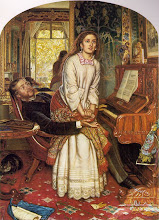
Desperate Romantics, Then and Now [UPDATED]

One of the saddest threads in the book is the story of the open marriage between the great designer and second-generation Pre-Raphaelite William Morris and his wife, Jane, with whom Pre-Raphaelite gadfly Dante Gabriel Rossetti was also in love, and with whom he lived in a house rented by Morris for that purpose. Everything, however, ended badly and sadly for everyone, and one can't help but feel terrible pity for all the players in the drama, especially those who, like Rossetti, strayed from the Brotherhood's original aim -- to bring a new social realism to art, and especially to religious art -- and began to put beauty for its own sake above all else, a privileging which surely led to Rossetti's mental deterioration and untimely death.
Then I was alerted by my friend Mrs. Darwin to this slice of modern life, which rang achingly true to what I'd just been reading in the lives of the PRBs. The story of this newlywed pair, given prominent place in the Weddings section of the New York Times, begins:
What happens when love comes at the wrong time?
Part “Brady Bunch” and part “The Scarlet Letter,” their story has played out as fodder for neighborhood gossip. But from their perspective, the drama was as unlikely as it was unstoppable.
The rest of the article reads like a brave attempt written by a sympathetic friend to clear the good names of Ms. Riddell (a reporter) and Mr. Partilla (an advertising executive), who are quick to point out that they did not have an affair while they were still on their first marriages, and that they will spend the rest of their lives trying to bind up the wounds their behavior has inflicted upon their children from those marriages. The article garnered many, many more comments than usual for a piece in what are essentially the paper's society pages. While some comments came in the form of well-wishes, a significant number shared the tone of this one:
Claiming credit for not having an affair while engineering the end to your marriage is like claiming credit for not speeding while driving drunk and causing an accident.
I actually had nightmares about this article after I read it. The ethos of personal happiness as the highest good, a goal for which one must go through fire (though that fire destroy everything it touches), and summon all of one's misplaced courage to achieve, is one with which I'm all too familiar from an earlier chapter of my life. Though my actions, by the grace of God, did not mirror those of the players in what is essentially a story of personal tragedy (one that someone at the Times inexplicably deemed "news that's fit to print"), I can fully understand the compulsions and the lack of compunction and other social barriers that encouraged Ms. Riddell and Mr. Partilla to blow up their own lives and the lives of all those dear to them.
One thing in the article that struck me as overwhelmingly sad is the theme of the inevitable messiness of life, "messiness" being a sort of unstoppable force that one is advised to accept and embrace, and which rationalizes the suffering of the innocents on the outskirts of the love story:
“This is life,” said the bride, embracing the messiness of the moment along with her bridegroom. “This is how it goes.”
I'm quite familiar with this ethos of messiness; it used to come at me from all sides, and it's larded throughout our culture, and trotted out with alarming frequency to justify a great deal of harmful behavior. Another New York Times "Vows" column that caught my eye last year for the same reasons was this one, with the added interest, for me, of both the bride and groom being opera singers, since I associate that messiness-to-personal-happiness equation with my own opera days. (New Yorkers might recall that the couple's "life coach" and minister, Aleta St. James, is the sister of Guardian Angels founder Curtis Sliwa, and became a news item herself a few years ago when she gave birth to twins well into her fifties, apparently via a donor egg.)
It strikes me that those who are working to uphold traditional marriage have far more to fear from the credo of life's inevitable messiness, tied to the goal of personal-happiness-above-all-else, than from any other quarter.
H/T: Korrektiv
UPDATE: Good analysis of the Times article here.
UPDATE 2: A well-written analysis by someone who's been there, which also references one of my favorite movies, The Squid and the Whale.
Subscribe to:
Posts (Atom)



 Posts
Posts


