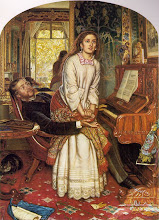
Showing posts with label longing. Show all posts

Saturday, August 17, 2019

Artists in the Kitchen


Among other Sisyphean pursuits, I've spent the summer culling books from my chaotic "library." It's been an anxious and painful task, because it's forced me to confront my neurotic used-book-buying habits, and to recognize the ways I've attempted to create a kind of escapist utopia in my house by populating it with library discards. I discovered early on in our sojourn in northern Appalachia that there are fantastic library book sales here, and it's hard to pass one by when hardcovers are $.25 (I suppose this says something about the reading habits of northern Appalachia or of post-industrial America in general, but that's for another post). Those library discards -- some of them truly wonderful books -- have then gotten unpacked and placed in half-hearted, meandering subject order on various already-groaning shelves around the house, with the result that, when I search the shelves  for a book, I can't find it, and I panic. So my first step this summer was to cull the duplicates, of which there were more than I care to admit -- because, if I find something wonderful that I already have, I always purchase it, because it's wonderful, and no one else will want it, and I might lose the first one -- a thought process that has ended up, more than once, with me not being able to find either copy of the book, and then buying another on Amazon.

I grappled with most of this, and ended up donating 17 boxes of books to the library for their next book sale, which I am planning to not attend, or at least to drive by with my knuckles white from my death-grip on the steering wheel.

There is one category of my collection, however, that I will not be culling. It is my two shelves of vintage spiral-bound community fundraiser cookbooks.

It's hard for me to explain how I feel about these books, which were published from the 1950s to the 1980s, produced by such organizations as the Women's Service League of St. Paul's Episcopal Church of Burlington, Vermont; the Valley Calligraphy Guild of Harrisburg, Oregon; and the St. Joseph Altar Rosary Society of Endicott, New York. Looking through them gives me a sense of excitement and anticipation, as if I've discovered a secret passage back to a lost world -- not only a time, but even a place, of wisdom that I lack: a world where a budget-stretching, wholesome meal made from cans of soup, packets of Jell-O, and bouillon cubes would draw a family together in a near-mystical communion, giving all its members the strength and comfort they needed to face the confounding exigencies of the world beyond the kitchen table.

I love to read the names of the recipes in my spiral-bound cookbooks. There is Priest's Goulash; there are Lasagna Rollups. There is City Chicken; there is Grandma's Waistline. There are Orange Chiffon Pie and Cottage Cheese Cake. There are many, many casseroles. Some of them from the late 1950s and very early 1960s are hand-lettered in an artistic, leftward-slanting calligraphic hand that must have been popular at that time, since it is found across vastly distant regions. Some of the hand-lettered cookbooks also include little pen-and-ink drawings by the recipes' authors, generally the cooks' own idealized images of times that were long past even during their own lifetimes.

I also cook from these books, and it is a great pleasure for me. The best of them recipe-wise are, perhaps unsurprisingly, compilations in support of big-city cultural institutions: I have, for instance, a cookbook produced by the staff of the Library of Congress; another, called Artists in the Kitchen, by the Women's Council of the the Memorial Art Gallery of the University of Rochester; and two published by the Junior Committee of the Cleveland Orchestra. One of my favorites, however, was created in 1973 by the staff and board of trustees of the Metropolitan Museum (pictured above). It contains a short foreword:

It is a little-known and indisputable fact that museum people devote a great deal of thought and time to food, and the fare at the tables of colleagues is more often than not of the highest quality. We hope that you will enjoy this collection of recipes . . . the Museum's first venture into the culinary aspect of the arts.

And the recipes are redolent of a mythical New York City past. There are such 1970s-era staples as hot crab meat, Roquefort cheese ball, and tuna casserole, and there are still hints here and there of the rapidly-fading favorites of an earlier spiral-bound era, like green rice baked in a mold. There are also some bizarreries that, in my fantasies about what "museum people" must be like, I could not have imagined -- such as this one for spaghetti sauce:


But most of them are charming, interesting, and even touching -- like this one, whose name, use of Teflon, and offhand acknowledgment that it "will do for a light supper," combine to make me sigh with longing for an easier time -- a time in which an omelette with a bottle of white wine and a green salad would have made a lovely Sunday supper, and in which you would have eaten it with someone who loved beauty and simplicity, as you do.


But this one treads, for me, uncomfortably close to pathos. Mr. Hawkins was a bachelor, who nevertheless "[impressed] his guests with this spectacular dessert." I think about Ashton Hawkins. Was the notation of his bachelorhood a signifier of gayness? Or was he, perhaps, just lonely? I think I would have liked to have sat at his table and been impressed not only with his spectacular Calvados Soufflé, but also with the wit and mirth of his company and his colleagues'.


And it's not just the bachelor Ashton Hawkins. It's also Margot Feely, who submitted a recipe for "Desperation Shrimp," a lifesaver when dinner guests show up unexpectedly. It's Katushe and Danny Davison, who "have lived in London for the past several years and have found themselves in the enviable predicament of having their freezer bulging with pheasants," and who, to clear some space, invented the "excellent dish" of Pheasant Hash. It's Edward M. H. Warburg, who avers that his Veal Casserole with Peas, and his Curried Eggs, "are amongst my wife's favorite recipes."

Where is Mrs. Warburg now? Where is Ashton Hawkins and all of his colleagues? As Czeslaw Milosz wrote in his 1936 poem "Encounter":

We were riding through frozen fields in a wagon at dawn.
A red wing rose in the darkness.

And suddenly a hare ran across the road.
One of us pointed to it with his hand.

That was long ago. Today neither of them is alive,
Not the hare, nor the man who made the gesture.

O my love, where are they, where are they going
The flash of a hand, streak of movement, rustle of pebbles.

I ask not out of sorrow, but in wonder.


Saturday, April 12, 2014

Lent: The Underground River


Lent has been bleak. I suppose that's how it should be: we're supposed to acquaint ourselves well with ashes -- with the taste of ashes, with becoming ashes. I've never been good at keeping up my prescribed penitential practices, especially where food is concerned; I've always felt as if giving up this or that food  was just too simple, too elementary, a mere beginner's step in the spiritual life, and that, since I don't have problems or obsessions or issues with food or drink, I'll just move on to the more advanced exercises, all of which shows, of course, exactly how warped I am by pride.

So this year I've been rigorous about, among other things, not eating between meals, and it's been surprisingly hard.  There's something so consoling about elevenses, or that late-afternoon bite of something -- so much so, in fact, that I've come to understand, this Lent, that turning to food has always been a way I've kept myself from crashing emotionally. This Lent, I've crashed.

I spend a good deal of time each day thinking about food, about certain tastes and textures, about how a bite of lemon pound-cake with a cup of black coffee at four o'clock, or a glass of flinty, ice-cold white wine an hour or so later, or even some peanut butter smeared on a saltine at midday, would make me feel. And I imagine that these things would make me feel resplendent, transformed, and would make life seem bright and gay, full of whispered possibilities. And then I shake myself awake and remind myself that this is food we're talking about -- ballast against hunger, disease, and death for most people in the world, and for most people far from delicious, much less redolent of fantasies and hopes -- and that building castles out of pound-cake is a distinctly First-World concern.

And then I think about the other things that I love, that I rely upon, that without which I would feel as if my life were truly a pile of shit. The main one is music. Slipping the Crooked Jades or one of Beethoven's late string quartets into my car CD player opens up worlds upon worlds for me as I drive through the bleak post-industrial landscape of my town; the music lends a warmth, a sort of hazy sheen to the phenomenal world, making what is often merely indifferent and sometimes hostile seem benevolent, making what's unendurable seem like a bad dream from which one will soon awake. But perhaps the world is not really so beautiful after all, and so I turn off the CD and navigate around the winter-cratered streets in silence.

And then I mourn, because, in these moments, it strikes me that everything I love is gone, or is going, and that everything good is disappearing from the world. The record of our earthly sojourn is one of loss. The annals of recorded sound, the smooth pages of poetry, are cries from beyond the grave, where we, too, are going, who knows when? "The curtain descends, everything ends/Too soon, too soon."


Sometimes I so envy our Pentecostal brothers and sisters. They have ecstasy, they have fellowship. We have rubrics, and wandering in the dark, and spiritual dryness. They go from door to door in the ghetto and ask people what they need -- do they need a window fixed, a bag of groceries, maybe someone to pray with them? And then they do those things for and give those things to those complete strangers, those others, those neighbors. My mother used to do this with her church. As for us Catholics, we shun each other at Mass and then have arguments in each others' comboxes.

As I was waking up this morning, I mentioned to God that I'd given up everything I loved for him. My old life, research, singing, travel, pretty clothes, intense friendships, fun, my beloved city, the feeling of being an expert, even an authority, at something. Having only two children means that I also have had to give up the happiness of babies after only a short time, and to move swiftly on to the difficulties of everything else, especially since both my children have medical needs. And adopting means always being aware of a former but unbridgeable pain and loss and wounding, and means praying, as I stumble around in the dark, that I might be able to assuage it, and realizing how impossible that is and how inadequate I am. However, since we don't generally have any of the ecstatic things, the waves of warmth and happiness, the mystical auditions, I got no response to any of this from God.

Lent always seems as if it goes on forever. It seems as if it will go on even after Easter is over. I've always thought that at some point, later on, in the future, everything will be settled and peaceful and good -- that one day the world which is hinted at in the music I so love will become apparent. But perhaps that will never happen, and we are all just headed down, into, as a character in a book I read put it, the underground river, from which there is no return and no going back.

One of Debussy's earliest songs is "Beau soir," with a text by Paul Bourget, which says, in translation:

When streams turn pink in the setting sun
And a slight shudder passes through the wheat fields,
A plea for happiness seems to rise out of all things
And mount up towards the troubled heart,

A plea to savor the charm of life

While one is young and the evening is fair:
For we are going away, like this wave is going away,
The wave to the sea, we to the grave.

I would like to have been able to add something to the annals of beauty, the record of loss, in my brief time here. I don't know if I will, but we must keep doing the work that's assigned to us each day.

Above: Pierre Bonnard, The Breakfast Room, 1930.

Thursday, April 19, 2012

Sehnsucht for Tots

I know something about longing, especially about longing for a past that may have never been what I now imagine it to be; I know reasonably well the dull ache for people and places gone forever, even when that longing is ontologically misplaced. I know all this not only from my own long and neurotic experience, but also from my schooling in the soundtrack of German romanticism, in which the keenest longing -- Sehnsucht -- is a guiding ethos.

My new son wakes up in the middle of the night and cries for hours and will not be consoled. My husband suggested that he, too, knows Sehnsucht. The present is better than the often-idealized past, but it's hard to explain that to a post-institutionalized, pre-verbal toddler in culture shock.

So this goes out to Jude; music by Schubert, text by Goethe:


Over all the hilltops
is calm.
In all the treetops
you feel
hardly a breath of air.
The little birds fall silent in the woods.
Just wait: soon
you too will rest.

Tuesday, January 17, 2012

"Like a bomb exploding our hypocrisy" [UPDATED]


By [one in] his or her right mind I mean vital, interested, questing, conflicted, on to one's own myriad defects and myriad gifts, preferably with a secret incendiary devotion to some doomed love/project/cause that promises to bear absolutely no fruit, compromises your physical/emotional health, and makes you look like a fool, loser and/or psychotic in the eyes of the world . . . .

The reason to save your first kiss till the altar, in other words, is not because you are so listless and etiolated and body-despising and intent on being a straight-A Catholic that you’ll suppress and deny your own God-given erotic urge, but because you are so vital, so juiced, so wild with longing, so crazy about your spouse-to-be that you want to make your wedding night a work of art. You want to offer your wedding night to the whole world.

Read Heather King's recent post at Shirt of Flame. Above is the first movement, Allegro con brio, of the Beethoven Sonata op. 22, no. 11 in B-flat major, which she references (the moment I believe she is alluding to is at around 5:28, the return to the home key of B-flat -- not E-flat, as she has it -- after the exposition), played by Claudio Arrau.

UPDATE: Kissing before marriage is not a sin for Catholics, as Mrs. Darwin reminds us.  The priest Heather referred to in her original post seems to have been working instead from a list of ultra-Orthodox Jewish dating conventions. Maybe someone should send him this brief article from New York Magazine. An excerpt: 

[On] this moonlit Saturday night, standing on the outdoor esplanade of the Winter Garden [at the World Financial Center in downtown Manhattan], Chaim Singer, a 24-year-old yeshiva student from Kew Gardens Hills, proposes to [Chavie] Moskowitz, who, bouncing on her toes, gleefully accepts.  Instead of embracing her fiancé, she blows him a kiss. "It's pretty tough not touching," she admits. "That's one of the reasons why we get married so soon." Soon means after three to twelve dates.

Friday, July 15, 2011

Poetry Friday: Bedtime Story for My Son

Where did the voice come from? I hunted through the rooms
For that small boy, that high, that head-voice,
The clatter as his heels caught on the door,
A shadow just caught moving through the door
Something like a school-satchel.  My wife
Didn't seem afraid, even when it called for food.
She smiled and turned her book and said:
"I couldn't go and love the empty air."

We went to bed. Our dreams seemed full
Of boys in one or another guise, the paper-boy
Skidding along in grubby jeans, a music-lesson
She went out in the early afternoon to fetch a child from.
I pulled up from a pillow damp with heat
And saw her kissing hers, her legs were folded
Far away from mine.  A pillow! It seemed
She couldn't love the empty air.

Perhaps, we thought, a child had come to grief
In some room in the old house we kept,
And listened if the noises came from some special room,
And then we'd take the boards up and discover
A pile of dusty bones like charcoal twigs and give
The tiny-sounding ghost a proper resting-place
So that it need not wander in the empty air.

No blood-stained attic harboured the floating sounds,
We found they came in rooms that we'd warmed with our life.
We traced the voice and found where it mostly came
From just underneath both our skins, and not only
In the night-time either, but at the height of noon
And when we sat at meals alone.  Plainly, this is how we found
That love pines loudly to go out to where
It need not spend itself on fancy and the empty air.

-- Peter Redgrove

More Poetry Friday at A Year of Reading.

Monday, February 14, 2011

The Lone Pilgrim


At the waning of winter, I want to do nothing else but sit in solitude in a spot near a window through which only a little light comes with a steaming mug of tea close to hand and read Laurie Colwin.  In honor of St. Valentine's Day, here is a re-post from 2009 of an excerpt from her wonderful story "The Lone Pilgrim."

*****************************************************
The writers one loves become our friends, and revisiting my beloved Laurie Colwin is like seeing a great friend again after many years, and finding that your conversation is as easy as if there had never been a pause in it. This is from her story "The Lone Pilgrim":

You get used to a condition of longing. Live with it over time and it becomes part of your household . . . . You cannot fantasize being married if you are married. Married to Gilbert, what would I long for? I would not even be able to long for him.

Woe to those who get what they desire. Fulfillment leaves an empty space where your old self used to be, the self that pines and broods and reflects. . . . The feelings you were used to abiding with are useless. The conditions you established for your happiness are met. That youthful light-headed feeling whose sharp side is much like hunger is of no more use to you.

You long for someone to love. You find him. You pine for him. Suddenly, you discover you are loved in return. You marry. Before you do, you count up the days you spent in other people's kitchens, at dinnner parties, putting other people's children to bed. You have basked in a sense of domesticity you have not created but enjoy. The Lone Pilgrim sits at the dinner parties of others, partakes, savors, and goes home in a taxi alone.

. . . . [N]ow the search has ended. Your imagined happiness is yours. Therefore, you lose your old bearings. On the one side is your happiness and on the other is your past -- the self you were used to, going through life alone, heir to your own experience. Once you commit yourself, everything changes and the rest of your life seems to you like a dark forest on the property you have recently acquired. It is yours, but still you are afraid to enter it, wondering what you might find: a little chapel, a stand of birches, wolves, snakes, the worst you can imagine, or the best. You take one timid step forward, but then you realize you are not alone. You take someone's hand . . . and strain through the darkness to see ahead.


(Above:  "Love Locked Out" [1889] by Anna Lea Merritt, which was used for the cover of The Lone Pilgrim, the collection in which the story with the same title was published in 1981.)

Monday, September 13, 2010

Music and Memory, Part 16: The Gardener

When I was a young soprano, I studied with a teacher who had herself studied in Germany with the great post-war coloratura Rita Streich.  My teacher said to me once in a lesson --it must have been a particularly good one -- "You sound like Streich!" to which I replied, in proper soprano fashion, "Who?"  She proceeded to tell me about the great Streich, adding, as an aside, "What a Nazi."  I later found a recording of Streich, somewhat in her dotage, singing a concert for French radio of duets by Mendelssohn, Schumann, and Brahms with the Canadian contralto Maureen Forrester, who died earlier this summer.  This recording, sadly, is now out of print, but it is at the top of my desert-island list (in fact, I've already listened to it three times today).

This recording was very important to me for a number of years.  Not only is it wonderful -- the pared-down honesty and simplicity of expression demonstrated by these two singers, both of whom were past their prime at the time of the concert but whose artistry remained at the highest level, is both instructive and deeply moving -- but it also accompanied me during a very painful time in my life, a time of wrenching loss and longing which, while it lasted, was nonetheless beautiful, and still glows a little in the light of memory (the loss and longing that were to follow for me were far less lovely).

One song I particularly loved was the Mendelssohn duet "Gruß" (Greeting), set to a poem by the Romantic poet Eichendorff.  In a translation by Jakob Kellner, it goes thus:

Wherever I go and look,
in field and forest and plain,
down the hill to the mead;
most beautiful noble lady,
I greet you a thousand times.

In my garden I find
many flowers, pretty and nice,
many garlands I bind from them
and a thousand thoughts
and greetings I weave into them.

Her I must not give one,
she is too noble and fair;
they all have to fade,
only unequalled love
stays in the heart forever.

Eichendorff's sentiments nicely captured the longing in my own heart for a distant beloved, and Mendelssohn's setting, lyrical and at the same time pulsing with an energy which subtly undermines, with its freshness and optimism, the sadness of the text, provided a wistful soundtrack to my heavy heart in those long-ago days.  Here is a recording (sung in English) by the great British singers Isobel Baillie and Kathleen Ferrier.
 

It was at this time of year exactly that I began to see my own life as both illustrated and illuminated by this particular song.  And then, a few years later, I found out that Eichendorrf's poem was not in fact called "Gruß," but, rather, "Der Gärtner" (The Gardener), and that Mendelssohn had left off the last verse, which goes:

I seem to be of good cheer
and work to and fro,
and, though my heart bursts,
I dig on and sing,
and soon I dig my grave.

The last verse is the crux of the poem, and catapults it from wistfulness to heartbreak.

Brahms set the entire text in an early work for women's choir, harp, and two french horns; here is a rather lovely recording of what appears to be a Chinese (or Taiwanese, or Singaporean?) girls' choir, singing it in English.

Wednesday, April 7, 2010

Bill Monroe and Romantic Agony

The home page of my web browser is set to The Writer's Almanac, and to be introduced to a new poem at the start of the day rarely fails to provide me with a thrill. (For a while a couple of years ago I was also the crank lady who sent them exasperated emails about the lack of research and sloppy editing in their writer profiles -- things like getting the plot of my favorite novel, The End of the Affair,  entirely wrong, and making assertions along the lines of "the novels of Thomas Mann have now fallen into neglect" -- but they've improved.)

Although today is the birthday of William Wordsworth, the Writer's Almanac poem of the day is the text of a song by bluegrass legend Bill Monroe:

Sittin' alone in the moonlight,
Thinkin' of the days gone by,
Wonderin' about my darlin'.
I can still hear her sayin' good-bye.

Oh, the moon glows pale as I sit here.
Each little star seems to whisper and say,
"Your sweetheart has found another,
And now she is far, far away."

It reminded me of a recent conversation with Melanie B in the combox here, about the notion that all poetry is about nostalgia for a never-to-return Golden Age. And I was struck by how much the Bill Monroe song resembled the premise of Schubert's great song cycle Winterreise, the first number of which, "Gute Nacht" (Good Night), is sung here by Dietrich Fischer-Dieskau, accompanied by an unidentified pianist:

Having been disappointed in love, the nameless protagonist of Schubert's song cycle goes off on foot across the winter countryside, growing more and more alienated from society as his journey continues.  In the last song, he throws in his lot with an outcast, mentally disabled organ grinder who he sees wandering barefoot over the ice.

Here is the text of "Gute Nacht," by Wilhelm Müller, translated by Arthur Rishi:

As a stranger I arrived,
As a stranger again I leave.
May was kind to me
With many bunches of flowers.
The girl spoke of love,
Her mother even of marriage, -
Now the world is bleak,
The path covered by snow.

I cannot choose the time
Of my departure;
I must find my own way
In this darkness.
With a shadow cast by the moonlight
As my traveling companion
I'll search for animal tracks
On the white fields.

Why should I linger, waiting
Until I am driven out?
Let stray dogs howl
Outside their master's house;
Love loves to wander
God has made her so
From one to the other.
Dear love, good night!

I will not disturb you in your dreaming,
It would be a pity to disturb your rest;
You shall not hear my footsteps
Softly, softly shut the door!
On my way out I'll write
"Good Night" on the gate,
So that you may see
That I have thought of you.

While doing research for my book project recently, I came across an essay entitled "Wounds and Beauty" by the painter and scholar Bruce Herman.  Herman suggests that the prevailing Western notion of beauty since 1750 has been an emblem of the Romantic longing for the lost Golden Age:  "Beauty," he writes, "is everywhere colonized by the Romantic longing for perpetual youth."  Herman posits

the possibility of a clear-eyed adult aesthetic that bears the marks of Christ's resurrected body -- marks that memorialize suffering but move beyond it to redemption, healing, and eternity.  The ascended Christ still bears earthly wounds, and his new body can be treated as a starting point for a new aesthetic -- a broken beauty if you will -- and a means of working through and beyond pain to a perfection that need not participate in [Romantic] idealization.

Herman suggests that Romantic yearning is not only untenable, but unsavory, even antithetical to the Christian longing for heaven.  Indeed, the thread of complete personal annihilation, certainly antagonistic to the Christian ethos, hangs heavily over the Romantic quest for a lost Golden Age.  We should, Herman exhorts, long for the future in heaven, not for the past.

The Bill Monroe song has all the elements of the Romantic argument:  grief, loss, rejection in love, yearning for the past, solitude, and the countryside by night; but its protagonist restrains himself from the more Wertherian extremes of disappointed lovers of the previous century.  I suppose that if we are to mourn in this life -- and we are -- it's better to do it sitting alone in the moonlight for a spell than wandering off across the frozen landscape into ever-increasing neurosis and alienation.  It's worth remembering that the words of the most famous song by Bill Monroe's contemporary, Hank Williams, are “I'm so lonesome I could cry,” and not “I'm so lonesome I could die."

There are numerous performances of the Bill Monroe song on Youtube, but none by Monroe himself, so I'll leave you with this particularly fine one:
-

Friday, December 18, 2009

Bedtime Story for my Son

Where did the voice come from? I hunted through the rooms
For that small boy, that high, that head-voice,
The clatter as his heels caught on the door,
A shadow just caught moving through the door
Something like a school-satchel.  My wife
Didn't seem afraid, even when it called for food.
She smiled and turned her book and said:
"I couldn't go and love the empty air."

We went to bed. Our dreams seemed full
Of boys in one or another guise, the paper-boy
Skidding along in grubby jeans, a music-lesson
She went out in the early afternoon to fetch a child from.
I pulled up from a pillow damp with heat
And saw her kissing hers, her legs were folded
Far away from mine.  A pillow! It seemed
She couldn't love the empty air.

Perhaps, we thought, a child had come to grief
In some room in the old house we kept,
And listened if the noises came from some special room,
And then we'd take the boards up and discover
A pile of dusty bones like charcoal twigs and give
The tiny-sounding ghost a proper resting-place
So that it need not wander in the empty air.

No blood-stained attic harboured the floating sounds,
We found they came in rooms that we'd warmed with our life.
We traced the voice and found where it mostly came
From just underneath both our skins, and not only
In the night-time either, but at the height of noon
And when we sat at meals alone.  Plainly, this is how we found
That love pines loudly to go out to where
It need not spend itself on fancy and the empty air.

-- Peter Redgrove

Wednesday, August 26, 2009

"Beautiful city, we must part," part 2: The Groans of August


It's time for my yearly post on the month that obsesses my imagination.

This is the first time I've spent my favorite month outside of New York City in many years, and August in Appalachia, at least in my corner of it, has nothing at all in common with August in New York City. Back home in the city, the alert observer could perceive the shift in the position of sunlight and the not-unpleasant burning smell in the air that marked the change from high summer to summer's end, and all the uncertainty and the promise of newness that this strange, shifting time -- the real start of the New Year in New York -- brought with it. Here, there's no sense of change apparent, at least to my senses, which were developed and trained under a different set of circumstances: except for the mist rising from the mountains in the early morning, high summer continues.

I'm still walking around in heartbroken longing for my old city and for many parts of the life I once lived there, but it occurs to me more and more that walking around in heartbroken longing has been a constant in my life at least since adolescence. And the truth is that August, far from being a month worthy of commemoration, has traditionally been for me a month of awful loss and absurd failure. This brings me back to my old dilemma: does God want us to be happy? Or does he perhaps ask those of us who are inclined to grief to suffer it for Him, offering that suffering up for others in the expectant hope that He, in the strange efficacy of His economy of mercy, will use it for their healing and their joy? I know, in spite of all the self-esteem propaganda and New Age relativism I absorbed that told me I was essentially a good person, that I am not in fact a person who deserves joy, and the individuals for whom I most often consciously choose to offer my grief are probably not either. But I think some people need joy in order to live and heal, and I pray that God will give it to them, because He loves them so much.

As anyone who's read this blog for a time knows, I'm a pretty egregious sinner who's made some irrevocably bad decisions that have had dire consequences on the lives of others, as well as on my own. Every day upon waking, the prayer comes to my mind that God might use me for good. But how might He do this? Can the leopard change its spots? I am still that person, that egregious sinner, that, for want of a better word, raging diva. But somehow, since the moment of metanoia that changed my heart in 2002, I'm also a different person. I want to trust that God will find a way to use the raging diva that He saw fit to reform for the purpose of demonstrating His unfathomable mercy to other egregious-sinner chicks like myself. Hopefully He'll make His ways somewhat clearer to me as I walk around, hearbroken with longing in August in Appalachia.

Above: "Dining Room Overlooking the Garden" by Pierre Bonnard, an image that has always looked like August to me.

Saturday, February 14, 2009

Happy St. Valentine's Day


The writers one loves become our friends, and revisiting my beloved Laurie Colwin is like seeing a great friend again after many years, and finding that your conversation is as easy as if there had never been a pause in it. This is from her story "The Lone Pilgrim":

You get used to a condition of longing. Live with it over time and it becomes part of your household . . . . You cannot fantasize being married if you are married. Married to Gilbert, what would I long for? I would not even be able to long for him.

Woe to those who get what they desire. Fulfillment leaves an empty space where your old self used to be, the self that pines and broods and reflects. . . . The feelings you were used to abiding with are useless. The conditions you established for your happiness are met. That youthful light-headed feeling whose sharp side is much like hunger is of no more use to you.

You long for someone to love. You find him. You pine for him. Suddenly, you discover you are loved in return. You marry. Before you do, you count up the days you spent in other people's kitchens, at dinnner parties, putting other people's children to bed. You have basked in a sense of domesticity you have not created but enjoy. The Lone Pilgrim sits at the dinner parties of others, partakes, savors, and goes home in a taxi alone.

. . . . [N]ow the search has ended. Your imagined happiness is yours. Therefore, you lose your old bearings. On the one side is your happiness and on the other is your past -- the self you were used to, going through life alone, heir to your own experience. Once you commit yourself, everything changes and the rest of your life seems to you like a dark forest on the property you have recently acquired. It is yours, but still you are afraid to enter it, wondering what you might find: a little chapel, a stand of birches, wolves, snakes, the worst you can imagine, or the best. You take one timid step forward, but then you realize you are not alone. You take someone's hand . . . and strain through the darkness to see ahead.


Above, the cover of the book of the same title in which "The Lone Pilgrim" was published in 1981. The image is "Love Locked Out" (1889) by Anna Lea Merritt.

Saturday, January 17, 2009

The Aroma of Longing


Recently in the combox, some of us have been discussing longing. When I asserted that longing is the post-Romantic condition, Mrs. T corrected me: it is the human condition.

We live on one side of an old two-family house from the 1930s, and when we moved in, I had perhaps irrationally high hopes that our other-side neighbors, a young-ish married couple with no children, would become great friends of mine. But it was not to be. Soon after we arrived, they complained about our noise: our son, whose third birthday was nearing, is a very rambunctious boy, and my husband and I would talk in our bedroom, which abutted theirs, apparently past our neighbors' bedtime. We have tried to be sensitive -- I don't consider us a loud family (except for when I practice, when my husband plays the piano or his accordion, when my son is screaming, when I am yelling ... hmmm) -- but sometimes we forget. My husband was vacuuming the living room the other night when the wife called and said she had just gone to bed and could we please stop; it was, um, 8:30.

So this great friendship was not to be. But I have a kind of olfactory voyeurism into my neighbors' lives. The house has two separate basements, one for each side, with built-in chutes on the first and second floors to throw dirty clothes down to the laundry room. Whenever I open one of the chutes, I can smell what my neighbors are cooking. It always smells so good that I feel disappointed by what I'm cooking on my own side of the house (which is usually also quite good) and seized with longing for what they're having for dinner. They make a lot of popcorn, which is not something we have over on this side. And this morning, as I was throwing last night's pajamas down to the basement, I caught the aroma of their coffee. It was wonderful - cinnamony, inviting, seemingly nothing at all like the coffee I was brewing back home. I imagined what life must be like on the other side of the house: bathed in warm colors, with attractive, artsy knick-knacks strewn about. But my own coffee was good too, and the husband of the couple is getting his doctorate in something called post-subculture studies, so maybe it's just as well we didn't become friends.

Tuesday, September 9, 2008

Culture Wars for Losers

Although this blog does not generally delve into political issues, I'm going to suspend that unofficial policy just long enough to attempt to articulate what is most heartrending for me about the upcoming election. Ironically, my feelings resonate on some level with a previous commenter's rather snarky remark about "the losers in life."

In a recent blog post, Tertium Quid suggests that, though the culture wars may be waged by intellectuals, their rank and file members are those who consider themselves, in some sense, to be numbered among the aforementioned losers:

If Barack Obama expresses aspirations bottled, stifled, busted, almost lost, and possibly resurrected, Sarah Palin expresses such things for a different kind of voter. Governor Palin will suffer much during the next few weeks, an intense dose of what Senator Obama has become numb to, if not used to. I am afraid . . . that we are going to have a brutal election because a vocal and malicious minority in each party is sure that America is too small a country to nurture the aspirations of both those who cheer Senator Obama and those who nod their heads and smile at the words of Governor Palin.

So Obama and Palin (let's face it, the election is really between them) personify the intense longing of those on each side who believe that they have lost in the culture wars and that their time has now come. The sad thing is, neither Obama nor Palin, nor any other politician in post-utopian American, can fulfill that longing, which is, in many ways, not political but spiritual.