I've been wonderin' why
People livin' in fear
Of my shade
(Or my hi top fade)
I'm not the one that's runnin'
But they got me one the run
Treat me like I have a gun
All I got is genes and chromosomes
Consider me Black to the bone
All I want is peace and love
On this planet
(Ain't that how God planned it?)
-- From "Fear of A Black Planet" (Chuck D/Public Enemy)
* * * * * * * * * * *
We are living in fear of an Autistic Planet. This is the primary reason why so many, including Catholics who consider themselves pro-life, feel justified in their decision to risk the disability and death of their children and the children of their fellows by refusing the MMR vaccine.
Of course, they will tell you that this is not the reason they refuse it. They will tell you that the reason they are willing to risk death for their children and others' is that the vaccine was grown in a culture derived from the cell line of an aborted fetus fifty years ago.
This is supposed to be some kind of principled pro-life stand. It is not.
Here's why:
- The material cooperation with evil on the part of those who use the vaccine is so remote that it is devoid of any of the characteristics that would make it sinful;
- The willingness of self-styled pro-life anti-vaccinators to risk the death, from measles, of those who are immunocompromised and must rely on herd immunity to stay safe is in direct contradiction to any principle that purports to stand for life; and
- To deny the good that has come from vaccines, including those derived from aborted fetal stem-cell lines fifty years go, undermines Christian theology itself.
I know that some Catholics are calling vaccine refusal "conscientious objection." It is not. True conscientious objection admits that the dictates of one's own conscience are in opposition to the social conscience, and is willing to accept the consequences, including punishment, of following them. Conscientious objectors to the draft in World War II and Vietnam, for instance, willingly served prison time for their choice (draft dodgers who fled to Canada in the latter war were obviously not conscientious objectors). I have yet to meet or read of a so-called conscientious objector to the measles vaccine who would accept a similar punishment for following what he purports to be the dictates of his conscience. Rather, the argument they make is that one's own self-interest trumps the common good. Can someone explain to me how this argument can be legitimately called either pro-life or Catholic?
The Vatican has made it clear that vaccinating is neither an occasion nor a near-occasion of sin (see the link above). If this is so, then what is the real reason that so many apparently faithful Catholics refuse the vaccine, even if to do so announces to the world, in the starkest possible terms, that they do not love their neighbors as themselves?
It's because they fear autism. And because they believe in the debunked and compromised results of a corrupt and amateurish study, published in the Lancet almost twenty years ago, that linked the measles vaccine to a gut syndrome in twelve children and theorized that this syndrome somehow made them autistic (a study conducted by a doctor with undisclosed conflicts of interest, who has since been stripped of his license to practice, but has moved to the U.S., where he is exploiting some parents' Fear of An Autistic Planet for cold, hard cash). Apparently anything, including the death of children, is better than having an autistic child. Can someone explain to me how this fear of autism can be legitimately called either pro-life or Catholic?
I will not link here to any of the so-called Catholic commentary that tries to pass off the championing of personal freedom over the good of all as conscientious objection. Because it's not Catholic. It's libertarian. And libertarianism, in spite of all the recent Talmudic parsing by Catholic libertarians to make it seem Catholic, is not.
But let us be hypothetical for a moment and suppose that all these free-floating fears are justified. Let us imagine that big pHARMa really does want to change your child's genetic neurological structure in order to line its own pockets (never mind the fact that the pharmaceutical companies that make vaccines give millions of doses away to Third World countries and that vaccines are actually a loss leader for these companies). And let us suppose further that, in cahoots with Big Pharma, the governments wants, in Jenny McCarthy's evocative phrase, "the soul gone from [your child's] eyes]," probably in order to take your child from you and make him a ward of the evil state, or something like that.
Such fears, whether trilled in the strident tones of unabashed conspiracy theorists, or spoken gently by well-heeled Marin County parents (in a recent New York Times article, one mother rationalized that she had "meditated on it a lot" before deciding not to vaccinate her children; another explained that "[v]accines don't feel right for me"), are really the Fear of An Autistic Planet. Even Catholics, who embrace the birth of a baby with Down Syndrome and heroize the parents of such children, evidently want to keep the soul in their children's eyes, and would rather not vaccinate than risk having a child with autism. I am struggling to understand how this inherently ableist attitude is pro-life.
Finally, it is a denial of Catholic theology itself to insist, against all evidence and clear-cut statements from the Vatican's Pontifical Academy for Life, that the measles vaccine is evil. I do not deny that the basis for its creation -- using the stem cells from an aborted fetus -- was material cooperation with evil. But our faith teaches us that God can, and does, bring good -- even great good -- out of evil. The crucifixion of Christ was evil, undoubtedly the ultimate evil. But the cross, the Romans' barbaric instrument of torture and death, became the sign of our salvation.
The belief that vaccines cause autism, and that refusing them will prevent autism, is belief in magic. The belief that God can use anything to bring about a good effect, and that the measles vaccine has ultimately proven that God brings good out of evil, is Christian. The fear of autism is pagan. The love of all our brothers and sisters is Christian.
Saint Gianna Beretta Molla, whose daughter Maria Zita died of measles at the age of six, a year before the measles vaccine was introduced, pray for us!
Showing posts with label culture of death. Show all posts
Wednesday, February 4, 2015
Sunday, March 18, 2012
Guess You Can't Have Everything
"I admit I’d imagined a proto-feminist surrogate, perhaps using her money on her own education, but Vaina is who she is."
An American woman describes her experience of hiring a surrogate in India to gestate her IVF-conceived twin daughters.
Monday, February 6, 2012
Democrats, Republicans, and Abortion
I found this article on my computer today. I had downloaded it in .pdf format a few years ago, but never got around to reading it, since I was hard at work on my doctoral dissertation. It's long, but an essential read for anyone who's ever wondered how the party that once championed the downtrodden (which was also the party of Catholics: as the old joke goes, two Irish ladies are gossiping, and one says to the other, “Did you hear that Timmy Breen became a Republican?” “Can’t be,” says the other, “I just saw him at Mass on
Sunday”) came to embrace abortion, while the party of elite, moneyed interests and liberal Protestantism became the default defenders of the unborn. An excerpt:
Suppose . . . a politically savvy Rip Van Winkle in, say, 1965, perceiving that a movement to legalize abortion was gaining strength in the country, were asked, “Which of the two major political parties will eventually identify with that movement?” What would he answer? . . . “the Republicans, probably.” Why? “Well, in the first place, it fits pretty well into the Republicans’ private-property philosophy. ‘Let’s keep government out of a woman’s most personal property.’ Secondly, consider the demographics. The Republicans draw heavily from the upper-middle class WASPs, where the drive for population control has always come from. Abortion fits very well into the old eugenics mythology—the belief that you can improve the health of the ‘race’ by limiting the breeding of ‘undesirables.’ You can still hear echoes of that in the conversations of bicoastal Republicans. It wouldn’t surprise me at all if the Republican Party came out with a plank saying ‘We support abortion, in certain cases, for the nation’s overall health and well-being.’ Finally, consider the Republicans’ emphasis on the need for law and order and their conservative approach to welfare. The Republicans may not say this out loud but it slots right into their conservative ideology: abortion is good because, by holding down illegitimate births, it will cut down on crime and welfare costs.”
What about the Democrats? “Well,” Rip would say, “let’s start again with demographics. Consider the heavy concentration of Roman Catholics in the Democratic Party. The Church hierarchy would go bananas if any prominent Catholic Democrat—or any Democrat at all—came out in favor of abortion. The Church has consistently held that abortion is one of the gravest moral offenses because it involves the direct killing of an innocent human being. . . . It might even be smart politics for the Democrats to pick a fight with the Republicans on the abortion issue. Democrats like to boast that they protect the weak and vulnerable, those in the earliest and the final stages of life, the elderly, the weak, and the handicapped. Now, all the Democrats have to do is insert ‘unborn children’ into that list and they can beat up the Republicans every time on the abortion issue. I can hear them now: ‘Let the Republicans pick on the weak and vulnerable, killing children in the womb to cut welfare costs. We Democrats are the party of compassion, the party that sticks up for the little guy, including the littlest guy of all, the child in the womb . . .’” Having delivered himself of this well-considered prophecy in 1965, Rip Van Winkle goes down for his nap. When he wakes up and we tell him how the abortion issue finally sorted itself out between our two major parties, Rip says, “Huh? How could that have happened?”
Suppose . . . a politically savvy Rip Van Winkle in, say, 1965, perceiving that a movement to legalize abortion was gaining strength in the country, were asked, “Which of the two major political parties will eventually identify with that movement?” What would he answer? . . . “the Republicans, probably.” Why? “Well, in the first place, it fits pretty well into the Republicans’ private-property philosophy. ‘Let’s keep government out of a woman’s most personal property.’ Secondly, consider the demographics. The Republicans draw heavily from the upper-middle class WASPs, where the drive for population control has always come from. Abortion fits very well into the old eugenics mythology—the belief that you can improve the health of the ‘race’ by limiting the breeding of ‘undesirables.’ You can still hear echoes of that in the conversations of bicoastal Republicans. It wouldn’t surprise me at all if the Republican Party came out with a plank saying ‘We support abortion, in certain cases, for the nation’s overall health and well-being.’ Finally, consider the Republicans’ emphasis on the need for law and order and their conservative approach to welfare. The Republicans may not say this out loud but it slots right into their conservative ideology: abortion is good because, by holding down illegitimate births, it will cut down on crime and welfare costs.”
What about the Democrats? “Well,” Rip would say, “let’s start again with demographics. Consider the heavy concentration of Roman Catholics in the Democratic Party. The Church hierarchy would go bananas if any prominent Catholic Democrat—or any Democrat at all—came out in favor of abortion. The Church has consistently held that abortion is one of the gravest moral offenses because it involves the direct killing of an innocent human being. . . . It might even be smart politics for the Democrats to pick a fight with the Republicans on the abortion issue. Democrats like to boast that they protect the weak and vulnerable, those in the earliest and the final stages of life, the elderly, the weak, and the handicapped. Now, all the Democrats have to do is insert ‘unborn children’ into that list and they can beat up the Republicans every time on the abortion issue. I can hear them now: ‘Let the Republicans pick on the weak and vulnerable, killing children in the womb to cut welfare costs. We Democrats are the party of compassion, the party that sticks up for the little guy, including the littlest guy of all, the child in the womb . . .’” Having delivered himself of this well-considered prophecy in 1965, Rip Van Winkle goes down for his nap. When he wakes up and we tell him how the abortion issue finally sorted itself out between our two major parties, Rip says, “Huh? How could that have happened?”
Friday, February 3, 2012
"Get Back in Line, Or We Will Destroy You"
I haven't had much time to post here lately. No, I haven't been on the Great American Road Trip in my little beater Ford, now that I can drive one, but things have been busy. I took my son to see the pediatric neurologist 150 miles away -- not in the beater Ford, because I don't feel that comfortable getting on and off the highway yet, but on the Greyhound bus; I spent a few days with my ailing mother; and I finished the first part of a scholarly writing project that I'm trying to get under control before we have Jude (we still don't have a travel date).
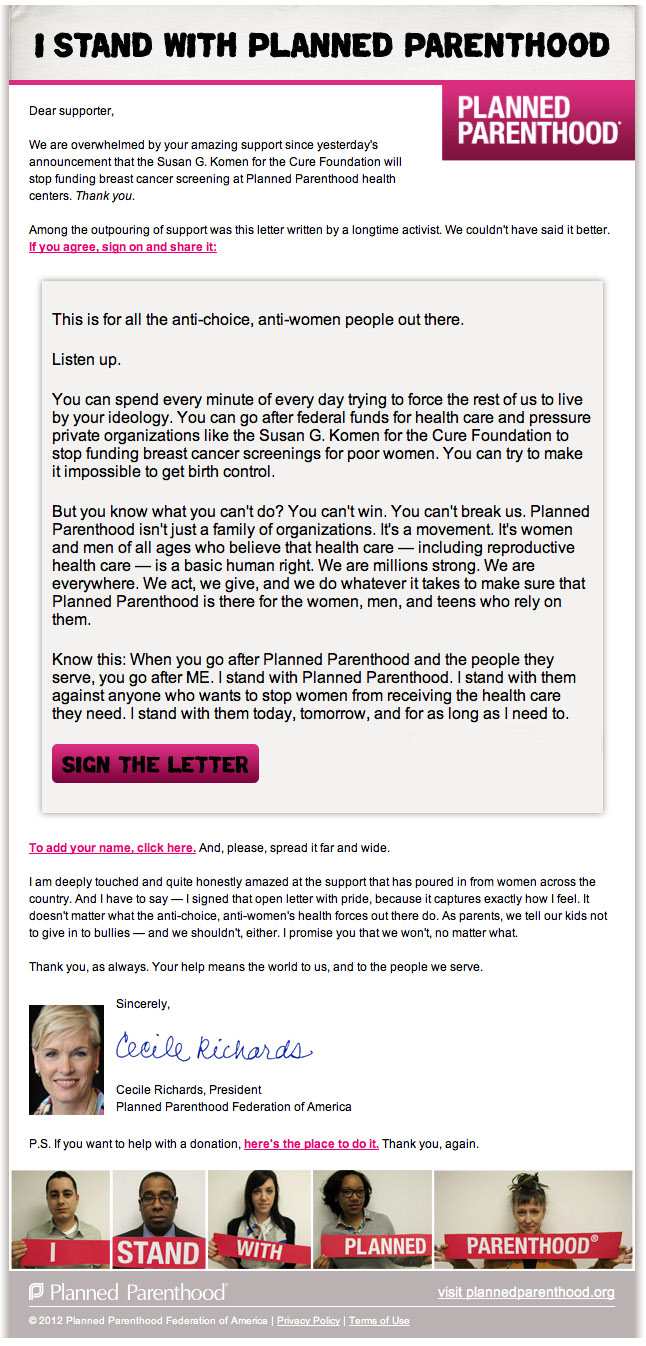
I'm really only here now because I wanted to link to The Anchoress's trenchant analysis of the Susan G. Komen fiasco. The truth is that Planned Parenthood leaked the news that Komen was defunding them, and then used it as a major fundraising opportunity of their own:
And so, like a good but weak soldier, Komen has essentially destroyed itself: hardline leftists will never forgive it; hardline rightists will never trust it. But feel a little sorry for Komen. They were trying to do the better thing, and they got mauled for it. They’re not cowards, they just weren’t strong. Not everyone can face the lions, especially if they’re being pounced on in their first steps.
I can't help but think that even the most die-hard Planned Parenthood fans might recoil from the bullying tactics, including the menacing, bring-it-on language, that the organization used to force Komen to its knees. But I'm probably wrong about that. It's not just the die-hard fans, after all, but even those who reluctantly accept the fiction that the destruction of human life is a defensible and necessary component of women's self-actualization, who become hardened a little, inured to seemingly small cruelties.
I'm really only here now because I wanted to link to The Anchoress's trenchant analysis of the Susan G. Komen fiasco. The truth is that Planned Parenthood leaked the news that Komen was defunding them, and then used it as a major fundraising opportunity of their own:
And so, like a good but weak soldier, Komen has essentially destroyed itself: hardline leftists will never forgive it; hardline rightists will never trust it. But feel a little sorry for Komen. They were trying to do the better thing, and they got mauled for it. They’re not cowards, they just weren’t strong. Not everyone can face the lions, especially if they’re being pounced on in their first steps.
I can't help but think that even the most die-hard Planned Parenthood fans might recoil from the bullying tactics, including the menacing, bring-it-on language, that the organization used to force Komen to its knees. But I'm probably wrong about that. It's not just the die-hard fans, after all, but even those who reluctantly accept the fiction that the destruction of human life is a defensible and necessary component of women's self-actualization, who become hardened a little, inured to seemingly small cruelties.
Labels:
abortion,
cruelty,
culture of death,
women's rights
Sunday, September 21, 2008
A Most Ingenious Paradox

Another commenter has taken me to task for “whining” about what she calls the “tragically unremarkable” losses I spoke of in the previous post, and for calling myself broken when in fact I am blessed – among other things, to have a husband who generously married me “in spite of” all my apparent, well, brokenness. I understand what she means, for indeed I am very blessed. At the same time, I do feel that I’m called to an open position of mourning, for the very reason that the circumstances of my life have been tragically unremarkable. If our culture of abortion is so prevalent that even a Catholic woman, as I am assuming the commenter to be, can tell one of her sisters who’s suffered from it to “stop whining” and “deal with it,” what measure of compassion can we expect from those who consider themselves pro-choice, but who are, essentially, anti-woman and anti-child? I feel like my mourning has to bear some sort of witness to this very unremarkable tragedy. If the mourning of those like me is allowed to go forth, perhaps more hearts will be changed.
And as for being blessed, yes: God is so good and His mercy is so unfathomable. As Christ told Saint Faustina, those who deserve His mercy the least have the most right to it. This is truly one of the most amazing paradoxes of Christianity. Today’s Gospel reading (Matthew 20:1-16, about the workers who arrive at the eleventh hour and are given a full day’s pay) illustrates it well. Man is limited by justice, but God’s mysterious mercy is higher and deeper than our imaginations can conceive. I pray that God may pour out his Divine Mercy upon all those who read and comment on this blog.
Tuesday, July 8, 2008
The Culture of Death and the Divinity Within
Dawn Eden has posted a video of an interview that Margaret Sanger gave to Mike Wallace in 1957. Here is Sanger's answer when Wallace asks her to define her religious beliefs:
Well, I have a different attitude about--the divine--I feel that we have divinity within us, and the more we express the good part of our lives, the more the divine within us expresses itself.I suppose I would call myself an Episcopalian by religion and there's a--many other, if you travel around the world you get quite a bit of the feeling of all--all religions--have so much alike in the divine part of our own being. And I suppose you just couldn't just put that into a book or you couldn't put it to a phrase or a sentence.
I was struck by the similarity between Sanger's tentatively-stated credo and the principles of the New Age spirituality that has become so pervasive in the past twenty or thirty years. The ideas that we have "divinity within us," that "the more we express the good part of our lives, the more the divine within us expresses itself," and that all religions are one sound as if they come from the playbook of any one of the innumerable channelers, energy healers, gurus and mystics of various stripes who inhabit the post-Christian American landscape. I never realized that there was a synergy between New Age spirituality and the blatant eugenicism of people like Sanger (and by extension, of Planned Parenthood), but I suppose it makes sense. The Nazi Party, after all, based its philosophy on an amalgam of occult belief systems from Theosophy to yoga; as Hitler himself told a Leipzig newspaper in 1931:
I intend to set up a thousand year Reich and anyone who supports me in battle is a fellow-fighter for a unique spiritual-I would almost say divine-creation. At the decisive moment the decisive factor is not the ratio of strength but the spiritual force employed.
Sometimes the facade of love and light that overlays the New Age cracks just a little to reveal what is really underneath.
For a comprehensive exegesis of the New Age, see the Pontifical Council for Culture's illuminating document Jesus Christ: The Bearer of the Water of Life, whose authors have given a sly nod in their title to the aspirations of the Age of Aquarius (and, lest anyone doubt the hipness of the Pontifical Council for Culture, the subheadings in the document refer to popular song titles, e.g. "Enchantment: There Must Be an Angel"; "Wholeness: A Magical Mystery Tour," etc.).
Well, I have a different attitude about--the divine--I feel that we have divinity within us, and the more we express the good part of our lives, the more the divine within us expresses itself.I suppose I would call myself an Episcopalian by religion and there's a--many other, if you travel around the world you get quite a bit of the feeling of all--all religions--have so much alike in the divine part of our own being. And I suppose you just couldn't just put that into a book or you couldn't put it to a phrase or a sentence.
I was struck by the similarity between Sanger's tentatively-stated credo and the principles of the New Age spirituality that has become so pervasive in the past twenty or thirty years. The ideas that we have "divinity within us," that "the more we express the good part of our lives, the more the divine within us expresses itself," and that all religions are one sound as if they come from the playbook of any one of the innumerable channelers, energy healers, gurus and mystics of various stripes who inhabit the post-Christian American landscape. I never realized that there was a synergy between New Age spirituality and the blatant eugenicism of people like Sanger (and by extension, of Planned Parenthood), but I suppose it makes sense. The Nazi Party, after all, based its philosophy on an amalgam of occult belief systems from Theosophy to yoga; as Hitler himself told a Leipzig newspaper in 1931:
I intend to set up a thousand year Reich and anyone who supports me in battle is a fellow-fighter for a unique spiritual-I would almost say divine-creation. At the decisive moment the decisive factor is not the ratio of strength but the spiritual force employed.
Sometimes the facade of love and light that overlays the New Age cracks just a little to reveal what is really underneath.
For a comprehensive exegesis of the New Age, see the Pontifical Council for Culture's illuminating document Jesus Christ: The Bearer of the Water of Life, whose authors have given a sly nod in their title to the aspirations of the Age of Aquarius (and, lest anyone doubt the hipness of the Pontifical Council for Culture, the subheadings in the document refer to popular song titles, e.g. "Enchantment: There Must Be an Angel"; "Wholeness: A Magical Mystery Tour," etc.).
Saturday, January 12, 2008
The Cross

I signed up recently to get the e-newsletter of Canadian Catholic artist and writer Michael D. O’Brien. I have not yet read any of his novels, but have a couple of them on request through the public library. They seem to be popular; although I made my request a few weeks ago, they still haven’t arrived at my library branch. What interested me in O’Brien is the fact that two of his novels feature as their hero the fictional Fr. Elijah Schäfer, a Jewish convert to Catholicism and a Carmelite priest. As some of my readers know, the current focus of my scholarly work is the association between music and conversion, and I have a special interest in conversion stories (interestingly, the Carmelite path is one that has traditionally brought Jewish converts into the Church, the most famous examples in our time being Saint Teresa Benedicta of the Cross, who was martyred, along with her sister Rosa – also become a Carmelite nun – at Auschwitz. Carmelite saints Teresa of Avila and John of the Cross were also of Jewish extraction, though it was their parents who converted). O’Brien is also a wonderful icon painter who incorporates native Canadian techniques and iconography into his work.
His monthly newsletter arrived in my inbox this morning, and it was astonishing. He writes about the culture of moral relativism (i.e. the culture of death) in a fresh, illuminating way that transcends the defensiveness and partisan bitterness I’ve come to expect from American conservative Catholics, who sometimes have a bunker mentality when it comes to accommodation with the current state of things. One of the hardest things for me to accept in the wake of my own conversion from being a semi-glamorous and entirely selfish single New York singer is that the values I once held, while in keeping with this state of things, are antithetical to the way of life I now attempt to espouse. I often console myself for this by telling myself that the conservative Catholics around me are anti-intellectual Philistines who can’t possibly understand how important my life and work are (until I remember that arrogance and pride are among the defects I must work the hardest to conquer).
Reading O’Brien’s newsletter, however, has made me understand why my old values and lifestyle are not in keeping with the new life I stive for. “The economy,” he writes, “continues to inflate according to the now dominant model of family income: The majority of households in my country [Canada, though it might as well be the United States] are double-wage families with two or less children. The cost of housing, food prices, clothing, in fact the cost of almost everything, rises and rises. Contraception, sterilization, and abortion are the foundation stones of this economy [italics added]. So, too, is greed-profiteering, avaricious forms of speculation, and that old thing condemned by God... Usury. Yes, unfair interest, the backbone of our economy. . . . Those who do not play by those deadly rules have many crosses to bear. These extra crosses are due to the sins and blindness of others. Too often, a conscious or subconscious rationalism has infected the thinking of contemporary man, even men of good will, and one could go so far as to say many a churchman as well. In their assessments of what is 'reasonable' and possible for marriage in our times they have minimalized, or dismissed altogether, the factors of grace and the transforming power of sacrificial love. It's a temptation to get bitter about it. But we mustn't. The Cross is always unfair. Jesus's cross was the biggest unfairness of all time. But he bore it like a lamb and he turned it into a sign that confounded every device of the enemy. “
O’Brien goes on to exhort his readers to “do the impossible. Let us indeed do what rationalists cannot understand, that is, let us do the supra-rational thing, the eternal thing incarnated into the present moment. I mean, begin to praise and thank God for each and every one of the trials he permits in your life. Then watch what He does. He works everything to the good for those who love him. Don't give up, keep on praising and thanking, and locked gates will open, unhealable wounds will heal, the kremlin walls of hopeless situations will crack and let in light. One crack at a time, one brick falling at a time, one victory at a time. One step at a time and only enough manna for one day at a time, just as it was for our forefathers in the desert. . . . in this way we will advance in the Great School of the Soul that is married life and family. For none of us will it be easy. In taking our first tentative steps of radical trust, we will grow stronger, and I think wiser, and then our strides will become longer and more sure. Trust grows the more we practice trusting. And with it love grows, and in the process the unexpected occurs, the ‘impossible’ in the midst of the glorious ‘ordinary.’”
Inspiring words, and strangely timed to coincide with similar advice I received yesterday. I had gone to the church in the garment district in whose thrift shop I bought my beautiful wedding dress (which I’ll blog about later), where I hadn’t been in almost three years. It’s a rather decrepit old church, which I suspect is on the archdiocese’s list to close, but it’s beautiful inside, filled with icons and lit with dozens and dozens of real candles. I got onto the confession line, and when it was my turn, was astonished to receive a simple instruction that was nonetheless radical and transformative. As some of my readers know, I experienced both an ectopic pregnancy and a miscarriage in the past year, and a priest in my parish told me that God might be chastising me for the past sin of abortion committed seventeen years ago, for which I’ve long since been absolved. When I asked him how such chastisement could be squared with God’s promise to Jeremiah to “forgive their sins and remember them no more,” this priest cautioned me against “taking scripture out of context like the Protestants do.” After several weeks of despair, I decided that this what he said was simply a lie, and it ruined my relationship with him, whom I had considered a friend.
The priest in the confessional yesterday, however, said something that changed my heart. What my parish priest meant, he suggested, was that God allows us to suffer so that we can join our sufferings to His on the cross and offer them to Him in reparation for our sins. This seemed so different from the punishment I had inferred from my parish priest’s words, so different from the cynical spiritual economy I had imagined as God killing two of my babies for the one I had killed. I decided to try it, and to experiment with the belief that God’s allowing us to suffer might be for our good rather than for our spiritual destruction. The arrival of Michael O’Brien’s newsletter today illuminated this theology of suffering for me in a timely and beautifully cogent way.
Subscribe to:
Posts (Atom)