Showing posts with label classical singing. Show all posts

Saturday, September 19, 2015

Music and Memory, Part 36: Walking Away

After a long illness, Christine, the wife of my friend and former opera colleague G., died a couple of weeks ago, just shy of her fiftieth birthday. I wasn't able to go to her wake or funeral because of my teaching schedule here in Northern Appalachia, but I've spoken with G. at length in the days since. G. is a wonderful lyric tenor, and, beyond that, truly one of the best musicians I know. For a number of years he sang in many of the great opera houses of Europe and America, but he withdrew from all of his contracts a few years ago to care for Christine, and because opera gigs are scheduled at least two years out, that meant his career was effectively over. A late bloomer who grew up in a working-class Irish-American family and spent his early adulthood tending bar and giving guitar lessons, G., after walking away from the opera stage, never looked back. He now lives and sends his daughters to college on the proceeds from his church job and a small income earned teaching music to the disabled.

I've known G. for a long time. We studied with the same voice teacher, and on Thursday nights we would meet at the Liederkranz Club on East 87th Street, which was around the corner from his house (but far from mine), to work out the opera arias we sang at our auditions with a quirky but gifted stage director. "I can still see you twenty years ago," he told me recently. "I can see what you were wearing, and your hair. You were this hilarious, talented Italian chick who just said THESE THINGS." I remember G. picking me up and driving me out to Long Island one evening to run through obscure arias with a brilliant pianist whom I'd never met and never saw again. "I don't coach my repertoire," he said that night, with a cockiness that, in his case, was wholly warranted. "I just know how the music is supposed to go."  He was on the cusp of a great career, and I was on the cusp, for reasons still not completely clear to me, of using my career as a tool in the blowing up of everything in my life.

G. has what I would call -- though he does not call it this -- a visionary gift. Since childhood, he's been able to correctly intuit certain people's fates, including those of relative strangers. He's often able to discern whether someone is going to die, and roughly when. In fact, he and his wife both had the foreknowledge, years before she became ill, that she would not live to see her fiftieth birthday. But this gift -- or call it what you will, and he's often prayed that God would rescind it -- comes in the context of his deep, even mystical, Catholic faith, a faith he and Christine shared. Because of this faith, the death of his beloved, though it's devastated him, hasn't utterly crushed him. He has a kind of palpable, tactile, tangible knowledge of God's great love for him, for Christine, and for all of us, and he talks about it often. It was G. who told me about the rosary novena after I came back to the faith, and I have prayed it during some momentous times in my life. While I'm not sure the novena has always "worked," it has changed my life.

I thought of all this recently when I read some caveats going around the internet against praying the novena to Our Lady, Undoer of Knots. Someone knew someone else who had prayed the novena, upon which the supplicant's life had rapidly started coming apart. A hard-line Catholic apologist I used to date mentioned once that he was terrified to pray to Saint Rita, because, according to popular legend, she would give you what you wanted, but it would come wrapped up in unconditional awfulness. And more than one friend has told me to be careful about praying the Litany of Humility, because that prayer was bound to be answered in particularly humiliating ways. But all of this goes back to the great fallacy of American Christianity across creeds: that when you embrace Christ, your life will get better. This is only a slight variation on that other characteristically American conclusion: that, if your life is good, it's because you deserve it (and conversely, if it's bad, it's because you don't, a faulty maxim upon which much unfortunate policy has been based). It's some combination of gnosticism, paganism, exceptionalism, and fatal self-regard, and it's so pervasive in our culture that, in spite of my own status as a miserable sinner, I have to remind myself multiple times a day that if my life has any good or happiness in it, it's not because of my relative merits. But if I lack merits, which I do, why do I possess or experience anything good at all? So many people I know have little, or even nothing, in their lives that is good. 

When G. and I became friends, I was married to M. He was an artist, and he strongly encouraged me in my singing. I wanted to get at something -- I used to tell myself it was the truth -- in and through my singing. I asked M. once if he would still love me if I stopped singing and did something else, say, became a lawyer. He didn't even entertain the question, because (he said) if I weren't a singer, I would no longer be myself. Ironically, M. is now a lawyer himself. 

Apparently one of THOSE THINGS that I said back in our aria class was along the lines of "I used to be Catholic, but no more." G., whose father is a deacon, took note of that statement. He brought it up recently, and reminded me that without my life blowing up, I would never have come back to the faith, which is true.

Towards the end of his short life, Henry David Thoreau, the great naturalist and visionary in his own right (one scholar has written a book about Thoreau's "ecstatic witness") seems to have lost his vision, the hypersensory awareness of the indwelling sublime that formerly had colored all of his encounters with the natural world. The mystic of Walden, who called the telegraph wire that ran along the railway "the telegraph harp," and wrote of it: 


by the end of his lifetime had reduced his writing to dry journal notations about the seasonal changes of various plants and animals.

I have in fact been praying the Litany of Humility for a long time now. My hope is that God will give me the humility to walk away from the dreams that damaged my life and the lives of those in my midst, and to do it with good cheer. You'd think this would have happened by now; we've been living in Northern Appalachia for almost seven years, and my professional energies have mostly turned from performance to teaching, which I love. But I still reflexively try to assuage my loneliness in this small (and in some ways sad) place with the old thoughts of my talent and the delusion that it gave me special privileges. I pray that I will be able to walk away simply, as G. did, because, as he knew, in the estimation of God there was something better and far more important to do.

Sunday, July 12, 2015

Music and Memory, Part 35: Lorelei

One summer a long time ago, I was a waitress at a popular restaurant in the publishing district. Late at night, at the end of a busy and generally lucrative shift, I would take a cab home with my tips rolled up in my little black waiter's apron. I was living at that time in Fort Greene, Brooklyn, a neighborhood that is now impossibly expensive, but was then a sort of African-American bohemia. A legendary experimental jazz musician lived nearby, and I was over at his house fairly often, because his girlfriend was a friend of mine. Spike Lee lived around the corner, and I would pass him walking his dog on my strolls through the neighborhood.

My apartment was at the back of the third floor of a brownstone, and it was quiet, which was nice, because I stayed up late in those days after winding down from the intensity of a busy night shift, and consequently I slept late in the mornings. It was a beautiful thing to be able to sit up in bed in the mornings and look out of the window and see not a concrete-paved airshaft, but the lush vegetation of old-growth trees-of-heaven filling the small lot that was my backyard, though I had no access to it, and the backyard of the brownstone on the block behind me. The fern-like branches of the trees -- ailanthus altissima, the eponymous tree of the great novel A Tree Grows In Brooklyn -- seemed to be piled up in the condensed space of the lot, frond upon feathery frond. They emitted a dark, dusty vegetable smell, the fragrance, to me, of a New York summer. I would get out of bed and make a quart or so of strong coffee in my little Italian stovetop espresso maker and drink it all, sitting at the table in my kitchen-slash-living-slash-all-purpose room. Then I would practice. It suited me to work at a night job, because I felt like I was giving the best energy of my day to my singing, and whatever was left over could be tossed casually into the hungry jaws of the chi-chi-restaurant-going public, which seemed to me, as Enid Bagnold wrote in another context in the wonderful book National Velvet, "like a million little fishes after bread."

I lived alone, and while the solitude felt rich and redolent, it was also devastatingly lonely. I was in love with M., and he had treated me cruelly. In my anxiety and sorrow I didn't have much of an appetite; besides the coffee -- Café Bustelo, which I made so thick that it could probably have been classified a foodstuff -- mangoes and Italian bread were the mainstays of my diet. One night, I recall, I sat alone at my table drinking Wild Turkey -- M.'s favorite libation -- while listening to Joni Mitchell, which, by the next morning, had caused me to swear off Wild Turkey forever, if not off M. or Joni Mitchell.

All during that summer and into the fall, a man sang in one of the apartments in one of the buildings on the block behind my own. Each day, across the thick, weedy verdure of the back lots, I heard this man's stentorian baritone boom out as he sang along to recordings. He would keep it up for at least an hour, and longer on Sundays -- sometimes the entire afternoon. I don't know what it was that he sang, or what he was listening to; the music and the words were indistinct, muffled by the distance across lots and absorbed by the dense urban vegetation. But it was something anthemic and simple -- likely a soul ballad, from what I could make out -- and he sang it over and over again. I can still hear his voice rising the interval of a major sixth, with a flourishing crescendo, at the chorus.

Rather than annoying me, I found the phenomenon of the invisible singing man and his incomprehensible, repeated song strangely comforting. It gave a rhythm to my day. Perhaps I was, for him, also an invisible singing presence, with my caffeinated late-morning vocalizing. I remember that during that time, I was working in particular on the song "Waldgespräch" by Schumann, about a man journeying through the woods, who is seduced and entrapped by the Lorelei; she tells him, in the last vocal statement: "You will never leave these woods again."

And perhaps I identified with the Lorelei, that siren of the Rhine who enchants men with her song. Believing that my own singing was a tool, likely the only one I had, I honed it in the hopes that it would precede me into the world and bring me back the things I wanted: security, peace, happiness, and love. But it didn't. And I was not the Lorelei. I was the hapless man in the legend, enchanted by myths of love and illusions of my own power. And everything that, at the time, I thought real and vital turned out not to be, though it took me many years to grope my way out of those woods -- even though they were not really woods at all, only Brooklyn back lots overgrown with weeds -- and see it.

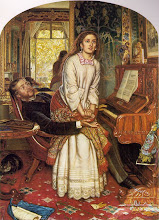
Above: La Belle Dame Sans Merci, J.M. Waterhouse, 1893.

Monday, May 26, 2014

In Memory of the Dead

A. E. Housman wrote his poem cycle A Shropshire Lad in 1896, so this excerpt is not really about World War I; but I can't hear George Butterworth's bittersweet setting of it without thinking of it as prophetic of the composer's own death in the Battle of the Somme, and the deaths of so many others in the flower of their youth. 

The lads in their hundreds to Ludlow come in for the fair, 
There's men from the barn and the forge and the mill and the fold,
The lads for the girls and the lads for the liquor are there,
And there with the rest are the lads that will neve
r be old.

There's chaps from the town and the field and the till and the cart,
And many to count are the stalwart, and many the brave,
And many the handsome of face and the handsome of heart,
And few that will carry their looks or their truth to the grave.

I wish one could know them, I wish there were tokens to tell
The fortunate fellows that now you can never discern;
And then one could talk with them friendly and wish them farewell
And watch them depart on the way that they will not return.

But now you may stare as you like and there's nothing to scan;
And brushing your elbow unguessed-at and not to be told
They carry back bright to the coiner the mintage of man,
The lads that will die in their glory and never be old.

Sunday, March 9, 2014

Lenten Grocery Penances for Bourgeois Outcasts

At the evening Mass on Ash Wednesday I sat in the pew realizing that, for all my pushing away the truth of the matter, I am a failure. The proof could not have been starker -- here I was, sitting in my coat in an unheated church in the ghetto of a once-thriving, now-crumbling Rust Belt town, far away from all the things that, to my mind, had long defined not only my own life, but even life itself -- the things that had nurtured my belief that I was special, out of the ordinary, made for something important.

My older son was with me, half asleep in the pew. I shook him awake to get in line for ashes, and when it was his turn, the priest -- a gruff, stern, socially-awkward west African man with a heavy accent and a hortatory preaching style, who is known to have conflicts with some of his brother priests in the diocese and who has been mostly benignly ignored by our parishioners -- murmured to my son, as he daubed the ashes onto his brow, "Remember that you are dust, my brother. And to dust you shall return." I was struck by this entreaty; after all, Father didn't call me "my sister" -- and I mentioned to my son that Father's words to him were special. And I believe that they were, because Father loves my autistic son, and I heard his words as not only an exhortation, but also a greeting cast out across the chasm of loneliness, from one outcast to another. I recalled Father hearing my confession a couple of years ago, when I was still wallowing in my own sense of exile and loneliness (well, I still am), and I mentioned it to him; he said, "Oh, my sister. I understand." In loneliness, I became his sister. As outcasts, we were next of kin.


Of course, I've mentioned my feelings of isolation in my new hometown too many times to count. They stem from the obvious: I'm far away from home; my friends and family are at a significant remove. I can go through a day hardly seeing another adult except through the glass of my windshield; driving, while making my life incalculably better, has increased my sense of isolation, and also, I fear, my complacency. When I was still walking everywhere, I was forced to confront the poverty of my fellow walkers in the city; now I am safe from them.


Not that this place hasn't also forced me to confront my child-of-the-utopian-seventies notions about poverty, too. I have reached out to a couple of poor mothers here, and found their lives and their children's lives to be hobbled by the kind of disastrous decision-making that right-wing pundits like to rail about. But I have made disastrous decisions too. I think I know something about the fear and despair that drives people to cling to even the most harmful and toxic attachments, and I have seen that the lives of the poor are shot through with a loneliness much worse than my own.


I see now how we hold ourselves back, apart, and away from people who are not like us, and how I have done this, too. My singing was the thing that I imagined could keep me safe from the misery of broken human promises and relationships, and of stumbling and falling attempts at human love. I had something I could use to put up a wall of protection between me and the lives of utter loss and failure that are common to the poor women I have known: a key, a tool, an instrument, a wedge.


To counter this still-prevalent attitude in myself, I'm doing grocery penance for Lent again this year. I'm going shopping at Aldi's instead of Wegman's, for starters, and putting the price-point difference in our Lenten sacrifice Jar to buy formula for medically-fragile Chinese orphans. This means that I have to forego the smug sense of self-satisfaction that Wegman's lulls me into, the sense of being with other people like myself: clean, bourgeois, well-educated, able to pick out the freshest and most beautiful groceries in a warmly-lit, expansive space. Instead, I must stand out in the cold waiting, along with the gray-faced night-shift workers, the toothless, tubercularly-coughing women, and the lank-haired young mothers of children in dirty coats who ought to be in school, for Aldi's to open its doors and let us in to its boxy cheerlessness, to fill our rented carts with foods in knocked-off packaging (the Benton's graham cracker box looks so much like the Honey-Maid one, but just isn't), with brand names, like Cattlemen's Ranch and Happy Farms, both vaguely euphemistic and reminiscent of Chinese communism. 


And it also means that I have to strive to stop exalting myself, my knowledge, my gifts, and trying to use them to pry open the world to give me the things that I want, and to try instead to accept and desire being forgotten.


In "Ich bin der Welt abhanden gekommen," one of the songs he wrote to texts by the Romantic poet Friedrich Rückert, Mahler succeeded in creating a sense of stilled timelessness, of dying to self and to the world. The text says, in translation:

I am lost to the world
with which I used to waste so much time,
It has heard nothing from me for so long
that it may very well believe that I am dead!

It is of no consequence to me
whether it thinks me dead;
I cannot deny it,
for I really am dead to the world.

I am dead to the world's tumult
And I rest in a quiet realm.
I live alone in my heaven,
in my love and in my song.

May it be so, eventually, for all of us.


Friday, February 14, 2014

Catholics with ASD Children and the Pro-Life Movement [UPDATED]

I had the unusual experience a few months ago of having a former mentor contact me to ask me to write a letter of recommendation for graduate school. M. was a remarkable soprano a few years my senior; as a young singer, I assiduously tried to pattern myself after her. But because of a combination of forces -- one of the most intractable of which was a difficult family situation -- her career was not what it might have been. She eventually became the mother of a large family, got an advanced degree, and began working in another field. The graduate program she was applying to, however, was in music, and, though I hadn't heard her in years and wondered what the appeal of a performance degree could possibly be at this stage in her life, I was happy to write on her behalf, and delivered a sincere assessment of her numerous fine qualities as an artist, colleague, and friend.

We had been out of touch for a few years and, while working on the letter, I gradually learned that since we'd last spoken, two of her children had been institutionalized for Heller's Syndrome -- also known as Child Disintegrative Disorder or CDD -- one at the age of six. Once considered a distinct diagnosis, CDD is now, like Asperger's at the other end of the dial, rolled under the rubric of Autism Spectrum Disorder in the DSM-5, the standard diagnostic manual for psychiatric disorders. If CDD is indeed a cognitive disorder that falls on the autism spectrum, it seems like a particularly brutal and horrible manifestation one: the child develops perfectly normally until the age of three or four, and then loses not only speech, but every other acquired skill as well. At this age, children have some awareness of what is going on, and the affected ones are reported to have episodes of extreme terror -- perhaps because they are losing the ability to speak, to do, to comprehend -- before they shut down completely.

I don't know how one survives such a thing as a parent.

But it's not as if one can stop getting up in the morning.

I started thinking about what it's like, as a practicing Catholic (which M. is as well), to have a child with autism. My own son with autism is only mildly affected, especially relative to M.'s two CDD children, and living with him, in spite of some painful difficulties presented by his behavior, also brings its own kind of fulfillment and rewards. But I haven't experienced any support -- neither understanding smiles or kind words, nor extensions of friendship -- from my faith community. I've found it extremely hard to make friends with mothers of typical children, including those I meet at church, because my ASD son is so obviously different, and his behavior can be so disruptive, that people with the usual sort of children either withdraw, or simply don't extend themselves. (I've also received this response from progressive types, interestingly; it generally comes about after my son has gone along passing for normal for a time, and then suddenly does something egregious.)

While I've never seen mothers of children with autism embraced in pro-life Catholic (or any other) circles, mothers of children with Down Syndrome are very much celebrated in our community. Perhaps this lionization of DS mothers is based on the fact that, since prenatal testing can reveal the condition, and the law permits a choice of responses to it, in many cases the parents of DS children have consciously chosen life for these children, something that many in the wider culture do not do. So, if there were some kind of prenatal test that revealed autism in utero, and if mothers in these circumstances also "chose life" (which I would wager far fewer in the larger culture would do for autistic unborn children than they do even for DS), would these mothers find more support from Catholic mothers of typical children? I don't think so.

Children with Down Syndrome are generalized to be happy and loving, and even to have unique propensities for holiness; they are sentimentalized as "special" gifts from God for "special" parents. Children with autism are not. Children with Down Syndrome are welcomed, even celebrated, by people of faith; who can forget the near-hagiography surrounding Trig, the DS infant son of Sarah Palin, during the presidential campaign of 2008? Children with autism are not; in fact, when they are murdered by their parents, a chorus of voices generally arises to exonerate their killers. Children with Down Syndrome are viewed as sweet-natured, possessed of a unique sort of hidden wisdom, Holy Fools. Children with autism are . . . not. Even a beloved friend of mine, a faithful Catholic whom I respect and admire, told me that she would be happy to babysit for Jude, but not for my older son. (In her defense, she apologized immediately afterward, but I brooded about it for weeks.)

Even the panic over vaccines, and the increasing rates of vaccine refusal on the misguided ground that they cause autism -- and the vaccine-deniers cut through a cross-section of conservative and liberal -- underlines the point: no one wants a child with autism. Even in what we like to think of as the Catholic subculture -- the counterculture! -- the undergirding of our dominant American materialist-Calvinist culture bleeds through, and I suspect that parents of autistic children, and the children themselves, are seen to a certain degree as cursed by God, with an undercurrent of "who sinned, this man or his parents, that he should be born blind?"

If anyone looks at me, they have plenty of reason to confirm such a belief. I'm an egregious sinner. And my husband was in his forties when our autistic son was conceived, and there's a strong correlation between autism and paternal age. So people in our midst may breathe a sigh of relief if they have avoided our mistakes, or may congratulate themselves for their superior wisdom and virtue. They may even refuse vaccines. Perhaps they will thus be able to avoid both the very real difficulties and the very real loneliness of having children with autism. Or perhaps not. Who knows? But the persistent, underlying narrative, both in the larger world and in the subculture of faithful Catholics, is that autistic lives are less valuable, and far less desired, even than other disabled lives, and that if you get too close, some of it might rub off on you.

The Talmud suggests a prayer to be recited upon seeing a person who is disabled; perhaps it can be applied to people with autism as well, although they often do not appear different:

One who sees… an albino, or a giant, or a dwarf, or a person with dropsy, says ‘Blessed is He who made his creations different from one another.’ One who sees a person with missing limbs, or a blind person, or one with a flattened head, or a lame person, or one who suffers from boils or a person with a whitening skin complaint says, ‘Blessed is the true Judge.’ (Talmud Bavli Berachot 58b)

I do not expect to be celebrated by my co-religionists or anyone else for having an autistic child, but I would like not to be shunned. And I think that a real challenge at the heart of the pro-life movement is to formulate a loving response to the lives of those with disabilities, including the disabilities that are not immediately apparent, are not cuddly and inviting, and may not make you feel like a Good Person for embracing. For God is present in even the most disastrous of lives.

Friday, November 22, 2013

For Saint Cecilia's Day: The Secret Lives of Singers

The fact is, the business has changed a lot in the past few years. Singers with A-house credits take roles at regional companies to fill in their schedule gaps; instead of hiring established professionals for smaller roles, companies will often use students or locals who may be less experienced in order to save money; seasons and runs are both shorter; very few companies doublecast anymore. Many of my colleagues who sing leading roles and have many major credits have expressed nervousness over the fact that opera companies aren't hiring as far in advance as they have been used to. It's scary when you have a family to support and bills coming due, and your engagement calendar looms empty six months down the road.

"The past few years" is really since September 11, 2001.

I'm too busy to post. I have lots of things I want to write about here, but no time. I have to have the first draft of my research-intensive scholarly book in to the publisher on a short deadline, and I have lots more research to do, and very little time in which to do it. Also, I've been hired to teach a class in the music department of the local community college in the spring semester, and I have to prepare, because it's a subject in music that I've never taught before. 

Still, I feel moved to share this for the one or two people who might remotely be interested, because it made me nod my head vigorously up and down. I've been condemned in the combox here in the past by apparent would-be music critics, who suggested that I was failure as an artist because I haven't performed on the world's leading stages (although I think these readers, who don't know me and have never heard me sing, actually may have objected to me on other counts, and allowed their objections to shape their opinions of everything I do). Because I've spent most of my adult life as a working (i.e. paid) professional classical musician, have earned a doctorate in music, and still go out on semi-important gigs once or twice a year, I feel as if it's semi-important to set the record straight about my sort-of profession.

For the record, I had a friend, also a singer, who is friends with soprano Lauren Flanigan and used to bread-gig with her, and told me that Lauren in fact went to her temp job the day after she subbed in at the Met in the telecast performance opposite Pavarotti in Verdi's I Lombardi. Like so many singers, she was in debt.

Happy Feast Day!

Tuesday, March 5, 2013

Recordare

Ultra-light blogging, I know. I'm up against some intractable deadlines in my real-life projects.

In the meantime, there is this, from Mozart's Requiem. 

I think if Mozart had written only this one number and nothing else, nothing at all, he would still count among history's greatest musicians. I love the way that the piece's anxiety resolves into confidence in Christ's mercy.

The conductor is John Eliot Gardiner, the orchestra is the English Baroque Soloists, and the solo quartet is the exceptionally fine foursome of American soprano Barbara Bonney, Swedish mezzo Anne Sofie Von Otter, and the English tenor and bass Anthony Rolfe Johnson and Alastair Miles. The tempo is on the fast side, because the orchestra is playing period and period-replica instruments, whose sounds have a rapider decay than their modern counterparts.

The translation:

Remember, kind Jesus,
my salvation caused your suffering;
do not forsake me on that day.
 

Faint and weary you have sought me,
redeemed me, suffering on the cross;
may such great effort not be in vain. 
Righteous judge of vengeance,
grant me the gift of absolution
before the day of retribution. 
I moan as one who is guilty:
owning my shame with a red face;
suppliant before you, Lord. 
You, who absolved Mary [Magdalene],
and listened to the thief,
give me hope also. 
My prayers are unworthy,
but, good Lord, have mercy,
and rescue me from eternal fire. 
Provide me a place among the sheep,
and separate me from the goats,
guiding me to Your right hand.

Monday, January 28, 2013

Your Crooked Way

My children wake up during the five o'clock hour each morning, which means that I do too. I find waking up in the dark extremely demoralizing, though, and often am filled with dread first thing in the morning. In order to mitigate this sensation, I make a cup of strong coffee using this excellent device as soon as I get downstairs to the dark kitchen. The three of us then say a morning prayer, which always includes the petition that God will help us to make the world a more beautiful place that day, and we sing one verse of this, our morning song.

I've had a cold for the past few days, so the other morning, because I was losing my voice, I told my older son to lead the singing. "You can sing, Mommy," he encouraged me, "in your crooked way."

You can sing in your crooked way: I thought about this later, and the expression seemed apt. Hadn't I spent years, after all, singing in my crooked way? I remembered the period in my life when I thought that singing was all I had, my only pathway to salvation. As a young woman, growing up and going out on my own felt like launching a cobbled-together boat into dark and perilous waters, or flinging myself off a cliff into some dark void. The world struck me as unkind and unreliable, and love as fleeting and evanescent. If there was something I could do extremely well, I imagined, it could be my shield against the inevitable bitterness and heartbreak that love and the world would deal out. I could not trust love, nor my fellows, but I could wield my singing like a weapon to cut through the dangers they proffered. Other people might have more and better gifts than I had; other people might have the gift of love. But I could sing, and I loved to sing, and I developed a rigorous self-discipline that enabled me, over the course of years, to become a highly-skilled and effective practitioner of that art.

It's not uncommon even for singers at the highest levels to sing flat. I've heard it happen many more times than I can possibly count, including at the Met. Indeed, I've heard mediocre and even lousy performances there, as well as great performances marred by mistakes, bad notes, miscalculations, and musical train wrecks. It happens to everyone. I remember feeling particularly bad for Plácido Domingo one Saturday afternoon when he was singing the title role in the rarely-performed opera Sly, which ends with a tenor aria, and he flubbed the final sung note in the opera, leaving the audience not with the memory of a compelling performance but with that of a single lame high note. There's something touchingly human, though, about singing flat; it's as if the heart, the moment's emotions, the character's words, all cause one's voice -- or, to be technically correct about it, cause one's ability to accurately replicate pitch -- to fail, and doesn't that happen in everyday, non-singing life, too?

There was a period in my career when I was singing in the wrong fach.  I was a small-ish young woman, and my size, combined with my high energy, quick wit, and fast conversation, led some in the field to assume that I was the kind of soprano capable of high, fast, virtuosic singing. As it turned out, I could do the fast singing part, but I could never reliably sing the notes above high C, which is what the fach requires. A famous coach commented on my low speaking voice and the disparity between it and the high-sitting roles I was singing; an assistant conductor at the Met told me that if I even "went one fach lighter" I'd be "working everywhere." I tried to be lighter, higher, faster, perkier. Finally, though, when things were falling apart in my everyday, non-singing life, I began to remember the advice of people who'd known me and my singing for a long time, including members of my own (musical) family, who had always suggested that my voice would darken and deepen. I had wanted to be something else, someone else, but I was not, in fact, that person; and how can the voice be compartmentalized, treated as its own entity separate from the singer's own body and interior suchness?

I listened to my lesson tapes and watched my coaching videos and realized that, when I deviated from pitch, I was not singing flat; I was singing sharp -- above the pitch, even in repertoire that was, really, too high for me -- and I came to see that particular dysfunction as a metaphor for forcing myself into a box (fach, after all, means box) that was not the right size for me. Singing sharp, too, seemed very much in keeping with the use of singing as a weapon -- a sword is sharp, after all; a knife is sharp; so is  a switchblade. I switched to the lyric mezzo-soprano repertoire, a switch I've written about in more detail here, and everything settled into place technically; it felt comfortable, like finally finding clothes that fit after you've been wearing someone else's for the longest time.

I sang in my crooked way for years, and my aims, as an artist, were crooked too, in the sense that everything was predicated upon my singing. It was my heroin, the drug I immersed myself in when I was devastated, frightened, falling apart; it was my consolation when girls around me had husbands and families -- had love; I didn't need those things, or so I thought, since I could sing. It came before everything else in my life; I did not know how to have a life that did not heliotrope like a vine around the trellis of musical discipline and accomplishment. In fact, it was my life.

Even in the time since my own life has settled into patterns more closely resembling other, more usual ways of living, I haven't quite known where to fit singing into those alignments. I still sang, taught, researched, and performed after becoming a mother, but without the same . . . graspingness. I still believe that the ability to sing is a gift which, I now realize, God would have me cultivate (like all His gifts) in the interest of bringing beauty and consolation to others. I'm still trying to understand how to do that.

But I don't know if, in this life, I can ever leave my crooked way behind. I'm reminded of Auden's poem "As I Walked Out One Evening," in which the narrator, on a walk through London, overhears a lover declaiming the usual platitudes. Suddenly the declaration of love is cut short by "all the clocks in the city," who argue that

In headaches and in worry
Vaguely life leaks away,
And Time will have his fancy
To-morrow or to-day. . .

and exhort the lover and his listener to

. . . stand, stand at the window
As the tears scald and start;
You shall love your crooked neighbour
With your crooked heart.

I know now that my singing isn't the only thing I have; the only thing I have is my crooked heart. And because it's all I have, it's all I can give to this world; my crooked heart is the only means through which I will ever be able to live out my daily prayer to make the world more beautiful.  I pray that God will bring beauty and consolation out of my own crookedness.

Monday, November 26, 2012

Winterreise Smackdown

You know and love this performance.


But this one is better. (It starts at 13:34. Sorry, I couldn't find a video just of this one number.)


It just is.

Saturday, September 22, 2012

Music and Memory, Part 29: Pavane for a Dead Soprano

One early-summer day fifteen years ago I saw, while walking around my old neighborhood, a flier for an apartment sale -- one that promised opera scores, costumes, and gowns. Being not only a struggling young opera singer but also an inveterate apartment- and stoop-sale junkie, I made my way over to the address listed, a couple blocks from my own building. There I saw a middle-aged singer I knew by sight from the neighborhood, the friend of friends of mine, presiding over the sale of the contents of a pre-war tenement apartment, the kind whose walls have been painted so many times without being scraped first that they look wavy, with a bearded middle-aged man. I pieced together that the things for sale had belonged to the man's sister, a soprano. This woman, whom I did not know, had died suddenly of an aneurysm in the middle of a Thursday-night rehearsal for one of her bread gigs, a church job at the lovely little Dutch Reformed church just down the street, whose choir was blessed by an abundance of local talent in the form of struggling opera singers from the neighborhood (there were a lot of us). She was in her mid-forties.

The soprano must been a lyric coloratura. The ghoulishness of the situation notwithstanding, I made off with the Schirmer scores of Traviata and Lucia di Lammermoor, along with a pile of sheet music, some costume jewelry, and a couple of recital gowns. In fact, I bought so much of her stuff that her grieving brother, seeing me eyeing a tea-strainer -- the kind that looks like a little colander on a stick -- tucked it into the pocket of the big old man's shirt I was wearing. It appeared that he and the singer who I recognized from the neighborhood (she had sung with the dead woman in the church choir) had started some sort of romance, and I was glad for them.  On the way out, I saw a pile of the deceased woman's promotional postcards, no doubt ready to be mailed out to booking agents. They showed her in a variety of comedic poses, and I realized that the soprano, no longer young and easily cast-able as Lucia or Violetta, was attempting to move into character-actress work.

These memories came rushing back to me the other day when I saw Jude playing with the tea strainer, which has remained in my possession over the intervening years and four subsequent moves. I wondered if, like Babette, she was now delighting the angels in heaven, where she had become "the great artist that God meant [her] to be." I thought of some other middle-aged artists I had known from bread gigs of various kinds, some of them with prominent pasts: the former director of a theater program at a Midwestern university; the former award-winning fashion designer whose management company fired her for being too old when her long-time agent died; the tenor whose childhood of sexual abuse caught up with him just as he was achieving a stable degree of success, causing an undiagnosable psychosomatic condition that robbed him of the ability to walk; and many others. I thought about the untimely death from metastatic breast cancer of the luminous Lorraine Hunt Lieberson, who worked steadily and quietly for many years before achieving the international fame she merited, and then died at 52, and of the charismatic voice teacher with whom I'd studied briefly, who'd worked with Bernstein and been friends with Jacqueline du Pré and her widower Daniel Barenboim, and who opined that great musicians seemed to be canaries in some sort of global-spiritual-crisis of a coal mine; since so many of them died in their primes, there must be a cosmic plan to it.

At the same time, I recently finished a new memoir of bohemian New York, a literary genre of which I'm particularly fond, but this one did not call forth the bittersweet elegiac sense that the best of them do. In fact, this one -- ironically, written by a friend of mine -- I found depressing. The book chronicles the author's debauched young adulthood simultaneously with the transformation of Williamsburg, Brooklyn from shunned ghetto to chic arrondissement. I've never lived in Williamsburg and was not part of the circle he describes, but I felt a strange, unpleasant sense of voyeurism while reading about other people's drug-and-sex-addled days and nights, which took place during roughly the same time I was pillaging the dead soprano's apartment and my first marriage, along with my own opera career, was slowly unraveling.

I spoke recently on the phone with an old colleague from those days, a wonderful lyric tenor and devout Catholic who has sung in many of the world's major houses, including the Met, and, after the initial years of struggle, was having an important career. His wife has been battling a debilitating illness for the past few years, and he's cancelled some very important gigs in order to stay home and care for her. "I'm back to where I was fifteen years ago," he told me. He has a church job and is teaching for a foundation that offers free music classes to adults with disabilities. "And," he added, "I'm totally at peace with it." He left his wife at home for years with their children while he was out on the road; backing out of his major career now, he said -- a career that requires ten months a year away from home -- is the least he can do.

"And you," he said, "Look how far you've come." I didn't know what he was talking about. I hadn't had a major career. I'd left everything and moved to the middle of nowhere, where no one knows "who I am," or even, for that matter, who I am. I expend a great deal of my daily strength managing my autistic son's difficult behavior. I barely sing anymore.

But he explained that he meant how far I'd come spiritually. He knew me back in the day -- the young singer who bought the dead soprano's scores and gowns, the young singer who sacrificed everything sacred on the altar of ambition -- and I supposed that he might, in some way, be right.

Sunday, July 8, 2012

Music and Memory, Part 26: Heroin


About fifteen years ago I began the transition from pursuing a standard career as an opera singer to pursuing a recital career based mostly on the fruits my own research, a transition that would become final when I left my opera management the day before September 11, 2001. This change was precipitated by my meeting F., a wonderful Italian collaborative pianist and musicologist, on Saint Patrick's Day, 1996. Before long, we were researching and performing together, and he was my exclusive recital partner until he took a teaching job in Europe in 2005.

One day we were on our way to a gig in one of the mid-Atlantic states. We had walked from our late lamented neighborhood across the George Washington Bridge to Fort Lee, New Jersey, to rent a used car, had driven back to get our stuff, and now were on our way. On that drive, my colleague F. said two things that astonished me. The first was in response to my putting a Joni Mitchell CD in the car's player: he ejected it, saying, "Life is too short for bad music," and replaced it with a live recording that he had pirated himself at the Rossini Opera Festival in Pesaro, Italy (I continue to disagree with his assessment of bad music in this case). The second happened a little further down the road, as he told me about the sunsets, mountains, and animals he'd seen while on a concert tour in Brazil. "Really, Pentimento," he asserted, "all of that is far more beautiful and important than music."

I was speechless. How could that be? Music was my elixir; no, my medicine. Thinking more about it, I wondered if it might not, more specifically, be a sort of chemo drug, a life-saving medicine that carried the risk of certain potent side effects. Nothing was more important to me. It came before, preempted, and supplanted what should have been my most important relationships. My early life had been so tenuously established, my adult life so undisciplined; music was the only constant, and sometimes I felt it was a thing even more essential to my existence than a chemo drug would be: it was oxygen itself, the most basic ingredient for my survival from one day to the next. I clung to it like a vine that heliotropes its maundering way around a trellis to get to a patch of sun. Or maybe music was my heroin, the jab that could deliver a few hours of beauty and a sense of agency into an otherwise bleak life.

Performing -- even rehearsing -- with F. has been one of the high points of my life. Our musicalities complemented one another in a way I'd never experienced before. We had plenty of conflicts in our working relationship, but working with him was one of the essential steps in my maturation as a singer and musician. We performed together just once after he moved abroad, when my first son was one year old and I was pregnant again, though I didn't yet know it. Having a baby meant that I could no longer practice obsessively, as I'd always done before, and, as we rehearsed before the gig -- the only time we had -- F. stopped and said, "How is it that you're finally singing the way you always should have sung?" I suppose it had to do with lowered expectations, with not predicating a hundred other things upon my success in that one particular performance, and with having my single-minded focus distracted and dissipated by the needs of another person.

Now F. is far, far away, and so am I. And I wonder if there is some way to convert the heroin of my former life as a singer into some kind of methadone, to ease off my addiction to that intense inner world with a duller, less devastating version of it. It's been said that pop music anchors the listener to the place and time that he heard it -- that particular summer, that one party, that boy or girl -- and that, as such, it's a mnemonically static form, whereas classical music is redolent with all kinds of associative possibilities. I'm not sure I buy that; hearing any of dozens of classical pieces evokes for me the time and place when that piece entered my life, directed my thoughts, dominated the world of my senses. It's very difficult for me, for instance, to hear Beethoven's Symphony No. 6 without seeing a hundred moments from the years of my childhood to the years of my doctoral study; sometimes I cry when I think that Beethoven has to be dead, but I wonder if I'm not really crying for the past in general.

But the past is receding like a world seen through the wrong end of a telescope, and I must remind myself every minute to be here now, in post-industrial America, in crumbling northern Appalachia, a wife and mother, in the land where my own mother is dying and where my family members are wandering desultorily or struggling desolately, and where I seem to have lost the power and agency I once had when I was a young singer who lived for and through music.

(Above: Dame Maggie Teyte sings "Oft in the Stilly Night," which is not a folk song, as the announcer states, but rather one of the Irish Ballads of Thomas Moore, set to music by John Sullivan in the early years of the nineteenth century).

Saturday, June 9, 2012

No Shame in Smallness

In my final master's degree recital, I sang a group of Mozart songs, including a rather odd and rarely-performed one, "Verdankt sei es dem Glanz der Großen." Not being then the experienced and avid researcher I later became, I must admit that at the time I really didn't know what I was singing about. Yes, I translated every word, as I used to insist that my own students do when they were working on art songs in languages other than English, and I knew what it meant in literal terms; but the song, for all its simplicity, remained strange and rather mystical to me, and I assumed that it had something to do with Mozart's masonic affiliations. Here is a partial and paraphrased translation:

Thanks be to the glory of the great for showing me my insignificance so clearly. . . . I esteem those narrow boundaries in which I am so insignificant. Here I see stars and ornaments glistening, but they are of no interest to me, and cannot draw me out of my small circle. . . there is no shame in being small. 


It has crossed my mind lately that my life, background, and upbringing couldn't be more different from those of most of my readers here, including those whom I consider my friends. I was not raised for the life I'm living now. It's hardly necessary to detail the damage that I encountered early in life and later learned to replicate, but suffice it to say that I did not grow up with good values, morals, or catechesis, as you, perhaps, did. I did not go to Catholic school or university. I was not encouraged to become a wife or mother. I stopped going to Mass when I was eleven and didn't start again until years later. It never crossed my mind that a man would or should take care of me, and it wasn't something I particularly sought after or wanted. Rather, in spite of, or because of, my life of damage, I became a singer. From childhood on, I chased after the ethereal, the disembodied, the ungraspably beautiful that seemed to tend toward God (I would eventually learn that singing is anything but ethereal or disembodied). I tried to build my life on shards of color, scraps of sound, remembered fragrances and slants of light. In some ways it worked, and in others it failed miserably. I wonder if it failed because I was trying to make something hard out of something soft, something sharp-edged and useful as a tool or a weapon out of something warm and intimate. But in fact, I handled most phenomena in my life the same way.

Indeed, I never imagined what it might be like to be small in the essential way described in the text of Mozart's song, and the thought of being happy with such limitations frightened me. My whole life had been about kicking against the boundaries, pushing out of my way whatever conspired to keep me in smallness. So naturally I couldn't possibly understand what I was singing.

I went to Adoration yesterday, and it occurred to me that God is forcing me to grasp that kind of smallness now. I saw someone I knew there -- coincidentally, an Italian guy from the Bronx -- a tough-looking man with a shaved head who, seemingly uncharacteristically, indulges in extravagant gestures of devotion, including prostrations, frequent handling of a very large rosary on which he bestows loud kisses, profferings of monastic greetings when you run into him, and refusals to shake your hand at the Sign of Peace. I must stress that this is a genuinely holy sort of person, but I find the visible manifestations of the supposed state of his holiness a bit off-putting, and I have to admit to feeling chagrined that he was in the Adoration chapel when I walked in. I heard myself asking God, "Do You love this guy more than me? Come on, please don't love him more than me; You just can't!" which made me realize that, in spite of the fact that I was raised to make my own way in the world and for long stretches did so, all I had ever wanted was for someone to love me the best. In fact, I think that's the only reason I ever did anything.

But here and now, there is nothing but smallness. Not the life I had envisioned for myself. If being here in this crumbling post-industrial city is my school of humility, I'd rather have the school of walking around, of being among my people, of teaching my wonderful public university students: My Old School. Here it is hard work all the time and little excitement. Here there are many tears and few accolades. Here there are few opportunities to reveal that beauty that I always strove to uncover, which I later came to know was the beauty of God.

People from my old life email me and ask me when and where my next gigs are. I have to tell them I have nothing booked. I take care of my boys, each of whom has demanding and difficult special needs in different ways; I try to meet my freelance deadlines, which keep me on the edges of academia; and I try to keep the house clean. I try not to feel lonely and I try not to miss my old life, because it is gone, and probably some of it I'm well-rid of. I try to discern what God wants of me, and I can only assume He wants me to do what I'm doing now. Sometimes I long to go away to a hermitage, where I fantasize about the occurrence of profound healing and connection with God, but I understand that whatever healing and connection is going to happen is going to happen in the midst of confusion and brokenness, and I appreciate orthodox Jewish theology for insisting that the encounter with God happens in the midst of the chaos of family life and the marketplace; there is no precedent in Jewish tradition, after all, for monastic living, or celibacy, or hermitage.

Friday, May 18, 2012

The Voices That Have Gone, Part 12: RIP DFD

The greatest exponent of German art song of our age, and perhaps of any age, has died.

Otepoti and I have sometimes disagreed about the great Fischer-Dieskau. My personal preference is for a more direct expressive style than his -- one which, through the singer's masterful use of his body, allows an unfettered and elemental emotional resonance to join with the music; this may be heterodox, but I prefer Hans Hotter and Dame Janet Baker in this repertoire. Fischer-Dieskau could be too cerebral at times, too nuanced; at his worst, his singing lectured the listener, so to speak. But still, I loved him. Few singers, living or dead, could approach the humanity with which he sang.

The Times article notes that, unlike his frequent collaborator Elisabeth Schwarzkopf, Fischer-Dieskau never had to defend a decision to join the Nazi Party; he never joined. Like the Pope, he was conscripted into the German army, and while he was at the front, his cognitively-disabled brother was killed by the Nazis in one of their many institutions for this purpose. Fischer-Dieskau became a prisoner of war, and made his first Lieder recordings only days after being repatriated (because of food shortages, he sang without so much, I recall reading, as a sip of coffee in the morning of the recording session). I daresay that his emergence on the international music scene did much, in intangible ways, to rehabilitate the world's perception of Germany in the post-war period.

Dietrich Fischer-Dieskau was a great artist, and I surmise he was a great man as well, since we may be recognized as who we truly are by the good we do in the world. May he be rejoicing in heaven as I write this.

Friday, March 16, 2012

The Voices That Have Gone, Part 11: It Is Evening

When I was a young singer, I heard the second number in the video montage below, the Monteverdi duet "Baci cari," on a program on Columbia University's radio station, WKCR. I already knew and loved the controversial artistry of Elisabeth Schwarzkopf, but I had never before heard the compelling singing of her Vienna State Opera colleague Irmgard Seefried. Schwarzkopf and Seefried recorded a legendary album of duets in 1955, accompanied by English collaborative pianist par excellence Gerald Moore, which included the Monteverdi piece. Though in today's post-authentic-historical-performance age, no one with any pretensions to musicological know-how would dare to sing Monteverdi with a piano, I loved it so much that I sang it, with a wonderful soprano colleague, in the edition for piano in my M.M. voice recital.

Schwarzkopf, a Marlene Dietrich look-alike with an equally glamorous voice, takes the top line in all the pieces. Seefried, whose voice and aspect both convey more a sense of Mitteleuropean stolidity than Schwarzkopf's soaring emotional extravagance, sings the harmony throughout with a remarkably affecting purity, almost an aesthetic of austerity. To me, the highlight of the album is the Dvořák duet cycle Klänge aus Mähren -- Strains from Moravia -- sung in German. In this repertoire, the two voices just seem to work together so naturally, and convey such warmth and intimacy, and such a lovely sense of the conversational, that I've always imagined that Schwarzkopf and Seefried were true friends in real life.  Schwarzkopf, often expressive to the point of exaggeration, is beautifully restrained here, and the two sopranos sing together with an enviable simplicity, more touching by far than a more conventionally expressive interpretation. I couldn't find any selections of this repertoire on Youtube, so here is one of the Dvořák duets, "Fliege, Vöglein," sung by the American soprano Barbara Bonney and the German mezzo Angelika Kirchschlager. 

It is lovely, but to me, it lacks something of the naturalness, the simplicity, of the Schwarzkopf-Seefried performance.

In looking for recordings of the pair on Youtube, though, I found something that I thought astonishingly beautiful: Seefried, again with Gerald Moore at the piano, singing the well-known late Mozart song "Abendempfindung" (Emotions at evening). 

At first I thought the tempo was too fast, but after several bars it seemed to me the perfect framework for the delicacy and restraint of Seefried's interpretation. The text:

It is evening; the sun has vanished,
And the moon shines with its silver rays.
Thus flee Life's fairest hours,
Flying away as if in a dance.

And soon Life's colorful scenes will fly away too,
And the curtain will come rolling down.
Our play is done: the tears of a friend
Flow already over our grave.

Soon, perhaps (the thought arrives gently,
like the west wind, with a quiet foreboding)
I will part from this life's pilgrimage,
And fly to the land of rest.

If you will then weep over my grave,
Gaze mournfully upon my ashes,
Then, o Friends, I will appear
And waft you all heavenward.

And you, too, bestow a little tear upon me,
and pluck me a violet for my grave,
And with your soulful gaze
look gently upon me.

Weep the smallest of tears for me, and ah!
Do not be ashamed to cry thus for me;
Those tears will become
the loveliest pearls in my diadem.

Seefried's singing here seems like the embodiment of the violet in the  text, the most un-showy of flowers, and of the humble tears that become the most beautiful jewels in the beloved's crown. 

Thursday, March 8, 2012

One of Us

This was one of the  morning intercessions listed in Magnificat today:

For those who are rich in the gifts of the heart,
- that they may find blessing by loving those who are unlovable and unloved.

I was struck by the notion of being "rich in the gifts of the heart." What does that mean, exactly? When I was younger, I imagined that I was rich in this way, but I was mistaken about what the gifts of the heart really are. I fancied myself someone who had a limitless capacity to love, especially when it came to the men who interested me, men who tended to be sad, troubled, angry, addicted, oddballs or misfits, or some combination thereof.  Like many other women, I convinced myself that these particular men needed me in particular --  needed my own peculiar "gifts of the heart." I believed I had some sort of solace to offer in my love, something remedial, therapeutic, even redemptive; I even went so far as to believe that my ability to love gave me some sort of power.  I pictured myself wading out into deep waters, saving troubled men with the power of my love, men who would, in gratitude, love me forever in return. Strangely, that never happened.

Nonetheless these men were by no means entirely unlovable, just lonely (though a friend of mine used to caution that lonely guys were lonely for a reason). Still, they were intelligent, and relatively clean. When I ask myself now who is truly unlovable, a parade of images comes rushing into my mind: mentally-ill homeless men and women whom I saw on the subway or the street over many years; barefoot men and women whose feet were toughened and blackened with dirt, or who had improvised plastic grocery bags for shoes; men and women with wild hair and bulging eyes; men and women who stank so badly that they could clear a subway car; men and women I would shrink from. It would take someone rich in the gifts of the heart indeed to love these men and women, these brothers and sisters, these children of the Father. I was not that rich.

Our son Jude, who is coming soon, is a "waiting child." That is, he is in danger of being forgotten and unloved, and he might even be considered unlovable by some, because he has a birth defect.  But there are parents far richer in the gifts of the heart than I could ever be -- parents like self-professed Jesus-lovin' Air Force wife Sonia.

When I read the petitions in Magnificat today, what came to my mind, in addition to homeless men and women, was the cult-classic horror film Freaks. Freaks was made in 1932, before the Hays code began to be strictly enforced in Hollywood, and I'm quite sure it could never get made even today -- perhaps especially not today. It's the story of a circus troupe -- compellingly acted by a cast of actual sideshow performers with a variety of disabilities and deformities -- and its moral is that these "freaks" are more loving, more human, than the attractive, able-bodied strong-man and trapeze artist who are having an affair, and who plot to destroy their disabled colleagues. "One of us" is the motto of the freaks, who accept the trapeze artist as one of their own, in spite of the fact that she is an outsider who knows nothing of their own culture of mutual aid and kindness and who seeks to exploit it (this motto comes again at the end of the film with a chilling twist -- if you haven't seen it, I highly recommend it).

"One of Us" is also the name of a song by the little-known American composer Theodore Chanler, the last number in a song cycle called The Children, in which Chanler set poems by, of all people, Leonard Feeney, S.J.  I could not find any Youtube videos of this song, but here is the text:
 
Husbands and wives!
Are we not your little lives?

Fathers and mothers!
Who but we will be your others?

Why do you fear us, freeze us out of your heart?
One of us was Jesus;
He played our part,
In His little manger,
Smiling in His smallness,
To protect us from the danger
Of nothing-at-all-ness.

One of us was God.
Has this not been told abroad,
To some by song,
To some by star?
Then when will we be known
For what we are? 

I have heard this song performed several times by my friend and colleague Stephanie Jensen-Moulton, a gorgeous soprano and a scholar of music and disability studies. Fr. Feeney, who must have written the poem in the 1940s, was most likely referring to contraception, but Stephanie has noted that it also speaks eloquently to the question of who has the right to live. 

Since we can all accept that everyone has the right to live -- even the most disabled, the most deformed, the most likely to suffer, the most likely to cause suffering, the most likely to invoke horror, the most likely to die -- may we all become rich in the gifts of the heart. These gifts, like all of what Amy Welborn calls "gifts 'n talents," must be disciplined, and this is the hard thing. Love should be prodigious rather than prodigal. We must not be reckless in love; we must learn to love in the right way, that is, to love steadily rather than wildly, and with quiet force rather than frenzied ebb-and-flow. If everyone has the right to live, then we must not just accept that right in theory; we must somehow find a way to love everyone, even the unloved and the unlovable. I'm pretty sure that to do so is what differentiates Christians from pagans. 

As Father Zossima says in The Brothers Karamazov:

Brothers, have no fear of men's sin. Love a man even in his sin, for that is the semblance of Divine Love and is the highest love on earth. Love all God's creation, the whole and every grain of sand in it. Love every leaf, every ray of God's light. Love the animals, love the plants, love everything. If you love everything, you will perceive the divine mystery in things.