Showing posts with label musicology. Show all posts

Sunday, September 7, 2014

Music and Memory, Back to School Edition: Artificial Pearls

The music department at the community college where I teach moved to a new building over the summer. This is a good thing, even an excellent thing, since, up until now, the music department has been housed in a building that was apparently designed as a bomb shelter. All the classrooms in the old building were in the basement, and all their carpets were mildewed; I stopped reminding my students not to bring drinks to class, because the odor of stale spilled coffee was a marked improvement over what it could have been. The large number of linoleum tiles missing from the ceiling gave it the appearance of a menacingly-grinning, upside-down clown-smile, and the choir couldn't rehearse in the building, because so many of its members were stricken with mold-induced asthma attacks during practice.

Last week, before the semester began, we music-department adjuncts (who make up, incidentally, around eighty percent of the music faculty) converged upon the new building to clean it up and make it ready. It was a beautiful late-summer day, and my heart did strange things when I stepped outside the cinder-block building to make a phone call. The Soviet-bunker-style campus is nestled in a depression in the achingly-green northern foothills of the Appalachian mountains, hills that look so gentle, so kindly somehow. I thought about Wallace Stevens's "Anecdote of the Jar," about how the jar on the hill in Tennessee "made the slovenly wilderness/Surround that hill," and how, here, the anecdote was turned upside down: how here the hills surround the makeshift slovenliness of the college, but the artifice of man does not add order to or impose mastery upon those surrounding hills. I thought, too, of Emerson noting that

The God who made New Hampshire
Taunted the lofty land
With little men.

*     *     *     *     *     *     *     *     *

I've been asked to give a paper at a conference being held in honor of my dissertation advisor, an important musicologist now retired after many years of teaching, an Italian-American woman from Brooklyn with whom I became, during the time we worked together, somewhat uncomfortably enmeshed in a sort of artificial mother-daughter relationship. She remarked to a friend at my wedding that she hoped I wasn't going to take my husband's name, because I had worked so hard to build a scholarly reputation under my own (Italian) name. When my dissertation voice recital was approaching, she, apparently worried over what I would wear, confronted me awkwardly in the hallway of the university, where she was a full professor and I an adjunct, and anxiously enquired how I was planning to do my hair. When my first son was born, she said something I wasn't sure how to interpret at the time about how some people thought you should change your life for your children, and others thought you should fit your children into the life you already had; to this day, I don't know which camp she, a mother as well as a scholar, fell into. I still worry that I'm disappointing her with my hair, my life, and my scholarship, and I still don't know what my paper in her honor is going to be about. But I felt like hanging my head when I saw the website for the conference, and saw my name (the version of it that's trotted out for performance and publication purposes, Italian maiden name first, followed by married name) and my affiliation (northern-Appalachian-county community college) next to the names of well-known musicologists who teach at Case Western, The City University of New York Graduate Center, Harvard, and Yale. I recalled how I wanted to be something great, to do something important, and yet, here I am.

*     *     *     *     *     *     *     *     *

Someone once said that teaching is casting artificial pearls before real swine, which, to the extent that it's true, does not make the thrower of pearls any less swinish than his intended audience. How am I supposed to do this job -- to teach music to my students at northern-Appalachian-county community college? I want to do it, I burn to do it, because, as William Carlos Williams wrote (about poetry, though the same can be said about music):

It is difficult
to get the news from poems
yet men die every day
for lack
of what is found there.

I turned on the radio the other day while driving through my ramshackle post-industrial town, and I heard the adagio movement of a piece I know well, Mozart's Piano Concerto no. 27 in B-flat Major. I know it well because, when I was seven or eight years old, my mother had an LP of it that I would play over and over again. We had bought it while out grocery shopping; I had seen a display near the exit of LPs on sale for something like forty-nine cents, and this one had an image on the cover of one of Marc Chagall's designs for The Magic Flute -- Papageno, the birdcatcher -- though I didn't know this at the time. I begged my mother to get it. While driving the other day, I found that, though I hadn't heard the piece for years, I could sing every note of the piano solo and the melodic orchestral line. I noticed that the performance on the radio was actually played on the fortepiano, a forerunner of the modern piano, and that, delightfully, the soloist interpolated a fragment of Mozart's song "Komm, lieber Mai" into the cadenza in the coda of the last movement.
While singing along to the radio, I saw a shabby-looking, morbidly obese man with dirty legs riding in a self-propelled wheelchair in the oncoming lane. I thought about my mother's LP. Where would I be, who would I be, if my mother had not had it? Classical music is not salvific by any means (I remind myself), but, for me, it's always been anodyne, palliative, hallucinogen, and opiate all in one. It dulls pain, it comforts, it heals, it confers vision. Without it, I would be a miserable worm of a person, even more than I am now. And I wonder if this is true for everyone: if everyone, had he had access to my mother's record collection, would be a better person.

I thought about my wonderful voice teacher and mentor, A.B., who grew up, as it happens, in rural Tennessee. His parents were mountain people; his father was a self-taught singer who worked for a biscuit-flour company. The flour company would send out a string band to drive around the rural counties in a flatbed truck, from which they would play music, and then give a baking demonstration with a portable oven. A.B. told me about how, as a child, he was given a recording of the Nutcracker on 78s, and he listened to it until the records, as he put it, literally dissolved. He later found a recording of La Bohème at the public library, and played it, too, into the ground, memorizing every word and note of Rodolfo's Act I aria, but -- as he found when he got to conservatory -- memorizing it wrong, because the record had a skip in it that obliterated part of one measure.

Classical music, discovered as a child, taught me how to live, how to breathe. It did the same for A.B. I wonder if it might do the same one day for one of my students. I think of a recurring dream I've had for years, in which I am walking certain streets in New York that I know as well as I know the Mozart Piano Concert no. 27, but finding them slightly and ineffably altered, and looking for something as I walk -- something that, while I can't quite remember what it is, I know to be the key to everything. There's a beautiful children's book by Barbara Helen Berger called Grandfather Twilight, in which the twilight is personified as an old man who each night takes a pearl from an endless strand and walks with it to the sea, while the pearl grows larger and larger, eventually becoming the moon. I hope that the artificial pearls I offer to my students this semester -- not out of perversity, but because they're all I've got -- might be able to change into something real and beautiful for them, too.

Saturday, January 11, 2014

Music and Memory, Part 31: In Defense of the Folk Mass

When I came back to the Catholic Church a little more than ten years ago, I discovered something I'd been ignorant of as a child of the aggiornamento: that is, the division, fragmentation, and opposition among the multifarious branches of the faithful. In my few childhood years in the church, the idea of disunion was not on my mind, of course, and I loved everything about going to Mass and Sunday school. I loved the colorful vestments, I loved the felt banners, and most of all, I loved the music.

As a returning adult woman, however, I discovered that there was, in fact, some division within the Mystical Body. I discovered orthodoxy, and, not long after, the New York orthodox Catholic subculture, which included not a few cape-wearing, pipe-smoking, Chesterton-quoting, never-marrying-though-apparently-uncalled-to-religious-life-albeit-heterosexual Traditionalist men (there wasn't any female equivalent of this type that I could see; perhaps the young women of the cohort were all married with children, and thus didn't have time to spend cultivating a countercultural image). And I learned that I was supposed to scorn and deride the aesthetic trappings of the New Mass, while not entirely rejecting the Mass itself:  I was supposed to hate the vestments, the banners, and most of all, the music.

The young orthodox Catholics I was now encountering, though they were too young to have experienced the old rite, claimed to have discerned from early childhood that these aesthetic trappings were almost entirely lacking in merit. And their scorn was reserved in a special way for postconciliar liturgical music. It went without saying that Gregorian chant was the mode of sung worship par excellence; even polyphony was viewed with a soupçon of moral suspicion (as it had been, too, in the 1590s by a group of Italian composers and men of letters who wanted to be able to understand the words, and who, as a result, succeeded in inventing opera).

This surprised me, because -- perhaps very much unlike you, dear reader -- I loved that music.  My babysitter used to play her guitar in the sanctuary, her long braids hanging down over the body of the instrument, and sing liturgical folksongs, some of which I suspect were of her own composition. I loved her. I loved her long hair. I loved her singing, and I loved what she sang. In fact, it was in order to emulate her that I first wanted to become a singer myself (she also taught me how to say the rosary, and told me about the many miracles of healing at the Church of Saint Anne de Beaupré in Quebec. Maryann McCarthy, where are you now?).

I'm no chant specialist. Even among musicologists, the real chant specialists are few and far between. Chant is a whole musicological world unto itself, and the work of the vast majority of music scholars is focused not on chant, but on the music of the common practice period. And the fact that there are few chant authorities even among musicologists and musicians with doctorates, makes it safe to assume that that guy in the Tyrolean hat who took you out for coffee after Mass and, after reminiscing about the Habsburg dynasty, trashed the priest from southeast Asia who came out to help distribute Communion because he bowed before the tabernacle instead of genuflecting, is not one, either. This doesn't mean that I don't love Gregorian chant, of course. And I would venture to say that I actually do know more about it than that guy, though it wasn't the focus of my doctoral studies.

Whenever I'm told by orthodox, Traditionalist, or even serious-and-faithful Catholics who are not necessarily culture warriors, however, that postconciliar liturgical music is heretical or a desecration, I imagine that they're waiting for me, with my doctorate in music, to nod my head vigorously and offer some kind of musicological proof of their point. But I don't, because I love that music, and not just out of sentimentality or nostalgia for lost childhood. Some of that music is good and effective qua liturgical music, and I think that it's probably crappy execution of it that makes educated listeners think the repertoire itself is crap. This hymn is a particular favorite of mine; I love the coda in the chorus: "We will find an open door THERE; we will find an open door," where the word "there" lingers between doubt and hope on the fourth degree of the scale before resolving, consolingly, to the tonic. I'm not being ironic here. I couldn't find a decent performance of it on Youtube, which underlines my point -- though church music is not really performance. But I do not think the liturgical music of the 1970s and 1980s is monolithic crap; not at all. I've disappointed many people by saying so, but those many probably also don't love Michael Jackson or the music of Mister Rogers' Neighborhood (composed by Fred Rogers himself) the way that I do, either. And they should. At the risk of sounding hopelessly middlebrow, I will assert here that some of the music of aggiornamento is both beautiful and consoling. As Duke Ellington said, "If it sounds good . . . it is good."

I know I'm supposed to love music that is beautiful and reverent and old and serious and could be suitably transferred from the organ loft to the concert hall. And I do. But what's wrong with worshipping God with the simplicity of musical expression which is the extent to which most people are capable of producing musical sound and meaning? Our hearts and our tongues don't customarily address God in the language of the psalms, after all. The liturgical music of the 1970s that you think you're supposed to hate, or at least to laugh at, can be as much an ancillary or an inducement to worship, I believe, as can chant and Palestrina. We approach God in the Holy of Holies, yes. But we also have an everyday relationship with Him in which we accept and embrace His presence in the least dignified and the most mundane parts of our lives. There is a place, I would argue, for the hymns you hate: "for God is the simplest of all."

Thursday, November 1, 2012

Book News

I've been quiet here lately because of the big project that I mentioned a while back. That project was a book proposal, and the result (hoped-for, of course) has been that I've been offered a book contract, which is naturally an even bigger project. It's not the sort of book contract that some people maintain blogs in the hopes of landing (those people, of course, don't generally blog anonymously); it's a scholarly book on an obscure theoretical topic in music and cultural studies. It will be published in 2014 by a well-respected academic press, but it's extremely unlikely that I'll ever see any profits from it. In fact, I would be very surprised if, after its publication, more than a hundred people ever read my book, though I hope some scholars might find it useful.

Anyway, all this to say that I will be maintaining some kind of intermittent blogging routine over the next several months, since I will be working against a deadline, have a lot of research to do, and have limited windows of time in which to do it. There are lots of things I would like to write about here -- quietly, anonymously -- but for the most part I'll have to make use of my free time to work quietly and virtually anonymously on this other project.

Love to all in the meantime.

Friday, May 29, 2009

"Beautiful city, we must part"


This post's title is taken from Heinrich Heine's poem "Schöne Wiege meiner Leiden."

I returned to New York this week in order to receive my doctorate. I wept copiously on the train the day before commencement, as I headed down to the university to pick up my cap (the poofy, medieval, doctoral kind), gown, and hood. My tears on the train, shed at the very end of my doctoral studies, were a sort of inverse mirror of the tears I shed at the very beginnimg, when I sat for entrance exams, seven years ago. I had passed the voice audition, and the next requirement for admission was a written exam in music history, theory, and analysis. The test was extremely difficult; I knew more than one excellent singer who, unable to pass it, had been denied admission. I nevertheless believed I was doing a competent job until it came time to write a harmonic analyis of one of Schumann's Klavierstücke, chock-full of his typical deceptive cadences and briefly-tonicized key areas. At that point, I put down my pencil (word to the wise: always use a pencil, not a pen, for harmonic analysis), put my head in my hands, and wept. I had a non-near-death moment of seeing my whole life pass before me -- all the folly, pettiness, and misjudgements, as well as all the discipline, dedication, and hard work -- leading up to the present moment. In the end, I did not know why I was sitting there, taking the test that would, if I passed, admit me to the doctoral program in music. Was it the wrong choice, just another in a long chain of them? Was it random, or was it arbitrary? In that moment, it seemed as though my life entered a narrow tunnel, on a track upon which it had been guided without my noticing it by an unseen hand or by fate. I saw the smallness and futility of everything I had done, and it seemed to me that there was nothing else I could do but carry out the probably futile task at hand and attempt to complete the exam. In the midst of this existential crisis, the exam proctor came into the room to tell me I was out of time. I hadn't finished with the Schumann, but evidently I'd done enough well enough, for I was admitted.

I started out in my doctoral program as a student with a lot of promise. I had already garnered a small reputation as a performer of and researcher in some specialized musical repertoires, and in my first two years of doctoral study I read papers and gave recitals at some important international conferences, and published an excerpt from what would become my dissertation in a prominent scholarly journal. In the next two years, however, I got married and had a baby. I had to stop going to international conferences. I was asked to chair a panel at a scholarly conference when my son was seven months old, and, in spite of having made it clear that I would need to bring him with me, I was shocked by the open scorn with which we were received by some of the women attendees (this was not, interestingly, the case with the men, who were quite welcoming of me and my baby). I couldn't maintain my singing at a high level because I could no longer practice every day (still can't). For the first year of my baby's life I mostly just held him, and then, when he was one, I started teaching as an adjunct professor at my university (I had previously taught as a graduate teaching assistant), and picked up my dissertation again.

My life would probably have gone on as it was indefinitely even after I finished the dissertation during this academic year, but we left New York when a job opportunity came up for my husband. Being back, and witnessing the happy years of my doctoral work officially come to an end, was exquisitely painful for me. I miss my beautiful city terribly. I miss feeling deeply connected to and engaged with my work, my confrères, my surroundings. I miss my family and friends, especially Really Rosie, with whom I spent the day yesterday with our children; I pushed my stroller through Harlem crying when we had to part. I was reminded of the Elvis Costello song "New Amsterdam," in which he notes:

Back in London they'll take you to heart after a little while
Though I look right at home I still feel like an exile . . .


Here in New Amsterdam, I feel the same.

Wednesday, May 20, 2009

Hearing the Past


Some clever soul has written a Facebook program called "Musicology is Awesome," which allows musicologically-inclined Facebook users to send gifts like "Challenging Austro-Germanic Musical Hegemony," "That Dreaded Cultural Theory Reading Assignment," and "Illegible Cantata Manuscript" to their friends, who will only find these gifts funny if they're also musicologists.

Up until about thirty years ago, musicology was Austro-Germanic Musical Hegemony and Illegible Cantata Manuscripts, but, since the advent of the "new musicology," its focus has widened to embrace many musics (the new-musicological noun of choice), and it has become largely driven by Dreaded Cultural Theory. There are both good and bad aspects to this gradual transformation of a formerly stuffy discipline: among the bad are an overreliance on unconvincing post-structuralist theory and jargon, and tediously long articles in the Journal of the American Musicological Society, but among the good are the expansion of the canon of musical repertoire for serious scholarly study to include some wonderfully worthy genres that would have been laughed at thirty years ago. Also among the good (depending on how you look at it) is the fact that not everyone has to deal with Illegible Cantata Manuscripts anymore. Virtually all of the lost medieval and Renaissance manuscripts have been found (and their finding has been the basis of many a music scholar's career), which means that musicologists have to find other things to do, and there are lots of other things.

The bulk of my musical work as both performer and scholar has been in nineteenth-century music. It's great fun, if you're so inclined, to do research in the era known as "the long nineteenth century" (considered roughly to span the years between 1789 and 1914): documentary sources are numerous and well-preserved, and it's fascinating to peer into an era that, with the exception of advances in technology, was so strikingly similar to our own. In terms of performance practice, there is ample documentation in sound from the early days of recording, as well as notebooks, diaries, and musical sketches by composers and performers, as well as letters and reviews, that enable us to construct a reasonable notion of how nineteeth-century music sounded in its own day (this is not the case with, say, early music, whose performances, many of which strive for historical verisimillitude, are largely based on unverifiable conjecture about the performance practices of the day). We know, for instance, that Rossini hated it when singers interpolated notes above high C into his arias: he called this practice "singing in hair voice" (voce di capelli). And we can guess at the ornamentation style of the bel canto era from the earliest extant recordings, including this one by soprano Luisa Tetrazzini, which most modern connoisseurs would find tacky, if not cheeky. And we can wonder at the tempo and technique employed by the great Josef Joachim, friend and colleague of Johannes Brahms.

Unlike her interpretive style, Luisa Tetrazzini's vocal technique is not appreciably different from that used by singers today. But Joachim's extraordinarily pure tone and eschewing of vibrato are a different story. People just don't play the violin like that today, which indicates that not only music, and but also culture itself, were perceived differently a hundred years ago.

But analyze as we might, the one thing that we can never really know is what the world sounded like in the nineteenth century. What was it like to live at a time when the sounds of the countryside were gradually and then definitively supplanted by the cacophonous din of the city? What was it like when the first inventions for the amplification and transmission of sound -- the microphone, telegraph, gramophone -- were introduced? How did people hear the world before and after these new technologies? And how does our own hearing differ from that of our near ancestors?

In Brahms's day, the contralto was a common female voice type. He wrote his Alto Rhapsody for the great contralto Pauline Viardot, the younger sister of the great contralto Maria Malibran, and he wrote many of his most beautiful songs for the contralto Amalie Joachim, wife of the violinist, including the two op. 91 songs for alto, piano, and viola. But the contralto voice is virtually unknown now. Is the reason for its disappearance to be found in the way we hear the world?

To be sure, there are a few exceptional contraltos singing today, but they can be counted on one hand, and our age has a marked preference for higher, lighter voices in both women and men: witness the enduring popularity of soubrette-type sopranos like Kathleen Battle, Barbara Bonney, Anna Netrebko, and Dawn Upshaw (though, admittedly, Upshaw has expanded her repertoire far beyond what is typically sung by others in her vocal category), and the dubious rise of the countertenor over the past fifteen or so years. Is the shift away from darker to lighter voices a sign of progress or of a deficiency in our culture?

I'm inclined to think the latter. The virtual disappearance of the contralto voice -- deep, dark, womanly -- is, I think, like the disappearance of the blackbird from mid-nineteenth-century London, one of many small but sad outcomes of the stepped-up mechanization of modern life.

Here's a stirring example of what we've lost. Marian Anderson is like a vocal version of Joachim's violin: pure and radiant.

(Above: Brahms taking a walk, Vienna, c. 1880s.)

Friday, October 31, 2008

The Doctor is In


As of today, I'm Dr. Pentimento.

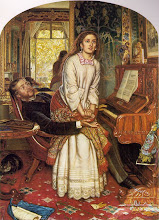
The image above, "The Awakening Conscience" (1854) by William Holman Hunt, is one of the subjects of my dissertation.

Tuesday, September 18, 2007

Musicologist Banned

I'm tempted to joke that more musicologists should be banned, but this is positively chilling. Nalini Ghuman is a member of the "Elgar Mafia," some of whose members are colleagues of mine, and whose only vices are far too boring and abstruse to mention here.